REVIEW · MADRID
Tour Madrid in 2 hours! Electric Tuk – Fast, Fun, and Exclusive
Book on Viator →Operated by Green Tours · Bookable on Viator
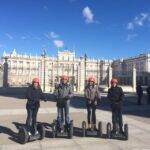
Two hours in Madrid, no wasted minutes. This private electric tuk sprint hits big sights fast, from Plaza Mayor to Bernabéu, with just enough time to look, snap photos, and get your bearings. You’ll get an English option and a mobile ticket so you can start right away without friction.
I love how efficient this feels. You’re covering central Madrid and then swinging out toward Salamanca and the stadium area without the stress of parking, traffic, or zigzagging on foot.
One thing to think about: this is built for speed. Most stops are short, so it’s more about quick impressions and photo angles than long museum time. If you care about a full sit-down visit, you’ll want to plan extra time for the interior sites.
In This Review
- Key highlights to look for
- Getting Oriented in Madrid by Electric Tuk (and why it works)
- Plaza de Santa Ana: a sweet start in the Centro rhythm
- Royal Palace of Madrid: grandeur from the outside, with a ticket catch
- Almudena Cathedral Museum + the Sabatini Gardens: church details and palace views
- Debod Temple: ancient Egypt in modern Madrid
- Plaza Mayor + Mercado de San Miguel: old-town heart in two quick tastes
- Literary Madrid: quick stops tied to Cervantes and Lope de Vega
- Plaza de las Cortes + Neptune Fountain: politics and myth, side by side
- Prado area + Jerónimos: art and faith for people who love landmarks
- Puerta de Alcalá: the kind of monument you stop for
- Las Ventas + Salamanca streets: Madrid expands fast
- Santiago Bernabéu + Paseo Castellana: modern Madrid’s headline
- Plaza Colón + National Library of Spain + Cibeles: monuments with a purpose
- Bank of Spain area + Gran Vía: the city’s big-street mood
- The guide factor: speed is good, but people make it great
- Is this tour good value for $215.07 per group?
- Who should book this electric tuk tour
- Should you book this tour?
- FAQ
- How long is the tour?
- What’s the price and group size?
- Is the tour in English?
- Where does the tour start and end?
- What’s included in the price?
- What’s not included?
- Is this a private tour?
- Can I cancel for a full refund?
Key highlights to look for
- Private group up to 4 for a calmer pace and less crowd pressure
- Electric tuk-tuk speed for hopping between neighborhoods fast
- English-speaking option for clear context as you pass major landmarks
- Most major sights are quick stops with many free entry options
- Palacio Real admission not included if you want to go inside
Getting Oriented in Madrid by Electric Tuk (and why it works)
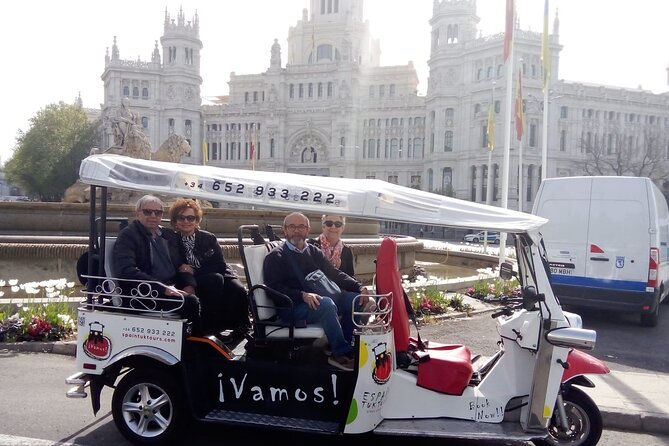
Madrid is big, but it doesn’t have to feel that way. A 2-hour private tuk-tuk tour is a smart first-day move because it gives you a mental map before you start choosing neighborhoods for the rest of your trip.
The tuk setup also changes how you experience the city. Instead of trying to “power-walk” between far-apart points, you can sit back for the ride, then step out for brief moments where it counts: a plaza to orient yourself, a viewpoint to frame the palace area, or a monument that’s worth one good photo.
You’re also paying for time and convenience, not just sightseeing. At $215.07 per group (up to 4), it works out to roughly $54 per person if you fill all spots. That can be a fair trade when you’re squeezing in a lot of highlights and want a guide to connect the dots as you go.
You can also read our reviews of more tours and experiences in Madrid


Plaza de Santa Ana: a sweet start in the Centro rhythm
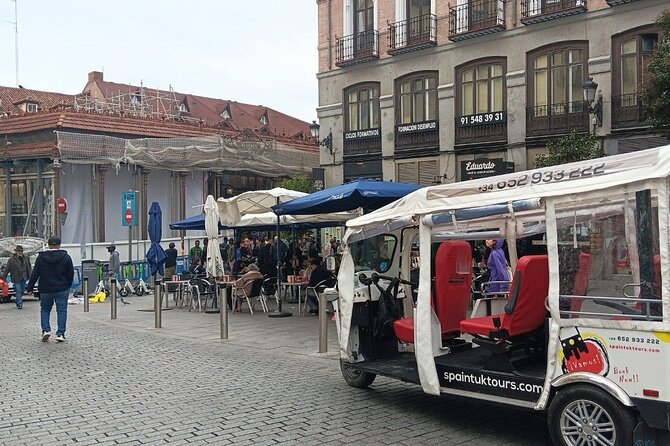
Your tour begins in the Retiro area at Pl. de la Lealtad, 1. From there, one of the first stops is Plaza de Santa Ana, in the Cortes neighborhood of Madrid’s Centro district. This open square dates to 1810, and it has been shaped by lots of urban changes over the years.
Why this stop matters: it’s a perfect “warm-up” plaza. You’re not committing to a long walk, but you’re dropping into Madrid’s street-level mood—wide enough to take in the surroundings, close enough to other old-town streets that you’ll later recognize where you are.
Royal Palace of Madrid: grandeur from the outside, with a ticket catch
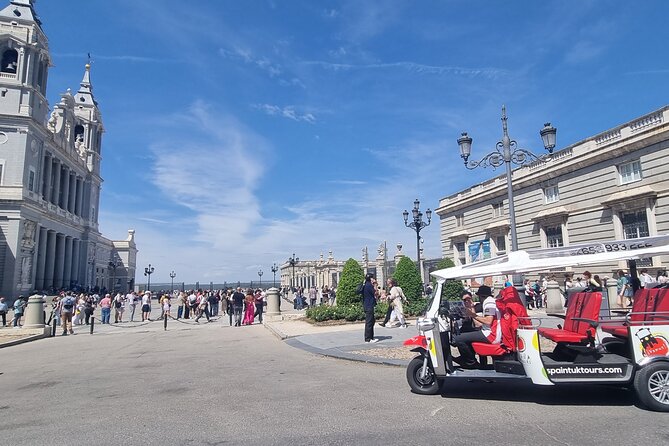
Next comes the Royal Palace of Madrid, also known as the Palacio de Oriente. Construction began in 1738 and took 17 years, and Carlos III made it a habitual residence in 1764. These dates matter because they explain why the palace feels so formal and “finished”—it’s a long project that shaped its identity.
Here’s the practical part: Palacio Real admission fee isn’t included, so expect this stop to be more about the exterior presence and nearby context than a deep interior visit. The palace is used for receptions, ceremonies, and official events, since the king’s residence is in Palacio de la Zarzuela.
If you want the interior rooms, plan a separate ticket day. But if you want the palace look to anchor your Madrid photos, this quick timing is actually ideal—because you’ll move on before you get museum-burnout.
Almudena Cathedral Museum + the Sabatini Gardens: church details and palace views
You’ll then stop at Museo de la Catedral de la Almudena. The Almudena Cathedral itself is a headline religious site: it was consecrated on June 15, 1993 by Pope John Paul II, and it was the first consecrated cathedral outside Rome.
The museum portion is designed for short attention spans—12 rooms that bring the diocese’s story to life with items ranging from mosaics to episcopal shields and ornamental pieces. Even if you only have a brief window, it’s a good contrast to the palace stop: same “grand central Madrid” energy, but more spiritual and local.
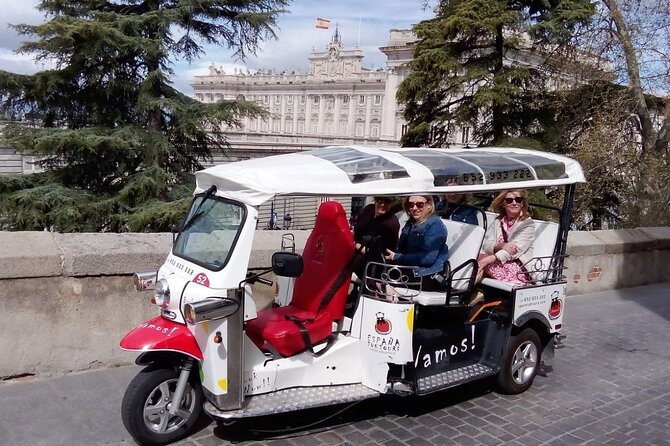
Right after that, you’ll reach Jardines de Sabatini, directly in front of the north facade of the Royal Palace area. These gardens cover 2.66 hectares and sit between Calle Bailén and the San Vicente slope. In a short stop, what you really get is framing—views and photo angles that make the palace feel less like a distant monument and more like part of a planned royal landscape.
Debod Temple: ancient Egypt in modern Madrid
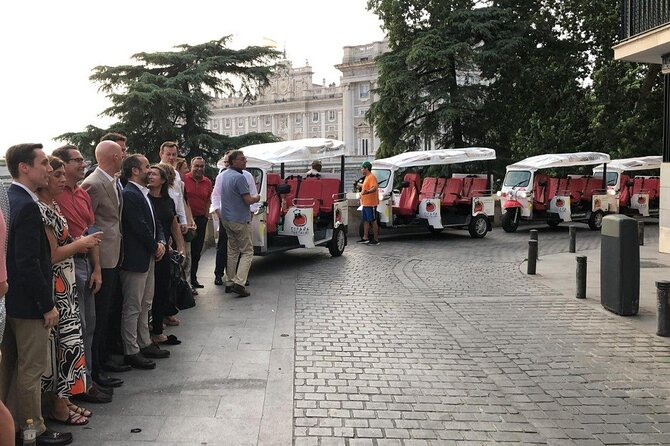
A standout shift happens at Templo de Debod, an ancient Egyptian structure placed in Madrid. It’s located west of Plaza de España, next to Paseo del Pintor Rosales, on a hill where the Mountain Barracks was.
Why it’s a good tuk stop: you can’t “wander” around this like a long museum day, but the quick arrival is exactly what you need. It gives Madrid a surprising cultural twist—one that makes your trip feel less like a checklist and more like a real story.





Plaza Mayor + Mercado de San Miguel: old-town heart in two quick tastes
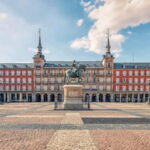
Then you land at Plaza Mayor, the old-town center around Madrid de los Austrias. This porticoed square started on the site of Plaza del Arrabal, with the popular market running until the court moved to Madrid under Philip II. In 1617, architect Juan Gómez de Mora was commissioned to bring building uniformity here—one reason the plaza looks so cohesive even centuries later.
Plaza Mayor is also famous for what happens around it over time: celebrations, bullfights, beatifications, coronations, and faith-related events. Even on a short stop, you’ll feel that layered “this is where Madrid gathers” energy.
Next is Mercado San Miguel, a covered market dating to around 1916. You’ll get a quick look at local food and delicatessen options, plus events in an elegant setting. This is one of those stops where you don’t need a long meal to benefit—you can taste the vibe and decide later where you want to eat.
Literary Madrid: quick stops tied to Cervantes and Lope de Vega
As you continue, the route includes literary landmarks connected to Spain’s Golden Age writers.
You’ll pass the former residence of Miguel de Cervantes, author of Don Quijote. The property offers guided tours, so it’s one of those places where the tuk stop can serve as a teaser: you get the location and the significance, then you can choose whether you want deeper time.
You’ll also see the House of Lope de Vega on Cervantes Street. It was built in the 16th century. Lope de Vega acquired it in 1610 and lived there until his death in 1635.
These are quick hits, but they’re more meaningful than random sightseeing. It’s Madrid’s way of putting literature into the real street fabric—so when you later walk these areas on your own, it feels less like wandering and more like moving through a story.
Plaza de las Cortes + Neptune Fountain: politics and myth, side by side
You’ll stop at Plaza de las Cortes, home to the Palace of the Spanish Courts. The building sits on the former convent of the Holy Spirit, which served as the seat of Congress between 1834 and 1841. That explains the site’s political gravity.
The facade has a neoclassical staircase and a portico with six columns. A triangular pediment rises above, and the famous lions flank the entrance. Here’s a detail worth storing: the lions were cast with iron from cannons captured in the war in Africa.
The bronze door beneath the pediment opens only on very marked occasions, so in this format you’ll mostly absorb the exterior and the building’s presence. But you’ll still get useful context about what’s inside. The building includes the well-known Session room, plus a library/conference room called the lost steps room.
A short hop later is the Neptune Fountain in Plaza de Cánovas del Castillo. Neptune is a neoclassical monument proposed in 1777, with construction starting in 1782 and completed in 1786. The practical win here is photo timing: the fountain is centrally placed, so it’s easy to capture without long walking.
Prado area + Jerónimos: art and faith for people who love landmarks
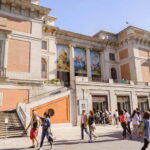
As the route continues, you’ll reach the area linked to the Prado Museum. The standout detail here is the sheer focus on European painting. Art historian Jonathan Brown is cited saying that the museum is the most important museum in the world for European painting. You’ll see that reflected in the list of major artists connected to the museum’s collections: Velázquez, El Greco, Goya, Tiziano, Rubens, and El Bosco, plus major names like Murillo, Ribera, Zurbarán, Fra Angelico, Rafael, Veronese, Tintoretto, Patinir, Antonio Moro, Van Dyck, and Poussin.
You may not have time to do the full museum inside on a tuk tour, but the stop gives you a “center of gravity” moment. If Prado is on your must-see list, this helps you plan how many days you’ll need later.
Next is San Jerónimo el Real, popularly called Los Jerónimos. It’s a parish church next to the Prado area. It’s late Gothic with Renaissance influences from the early 16th century. The church name connects it to a special relationship with Spanish kings, and it has historically been a spiritual retreat and a place of royal moments.
If you like architecture, this stop works well because the exterior and location are enough to tell you what kind of building you’ll see later when you walk the area again.
Puerta de Alcalá: the kind of monument you stop for
Then you’ll hit Puerta de Alcalá, a monumental neoclassical triumphal arch. It was built by mandate of Carlos III to replace an earlier 16th-century gate, and it was inaugurated in 1778. Designed by Francesco Sabatini, it’s a granite arc of triumph and the first built in Europe after the fall of the Roman Empire (as described in the tour info).
What makes it stand out immediately: it has five openings, unlike the usual three you see in similar gates. The decorations also vary between its two facades—useful detail if you’re the kind of traveler who likes comparing what the city saw when people entered.
For a tuk tour, a monument like this is perfect because it’s made to be noticed quickly. You’ll get a clean moment to look up, frame the arch, and move on.
Las Ventas + Salamanca streets: Madrid expands fast
Now the tour shifts from royal and old-town to a more modern, neighborhood feel.
You’ll reach Las Ventas, Madrid’s famous bullring. It’s described as the biggest bullfighting venue in Spain, with 23,798 spectators and the third largest in the world (after Mexico and Valencia in the provided info). The ring diameter is listed as 61.5 m.
A quick note on mindset: even if you don’t care about bullfighting, Las Ventas is a major city landmark. The stop is ideal if you want to see Madrid’s cultural scale beyond royal palaces.
Then the route moves into Barrio de Salamanca, including key streets such as Velázquez, Ortega y Gasset, and Serrano. This is where Madrid feels polished and shopping-forward compared with Centro. You’ll likely appreciate the contrast: the tuk makes it easy to shift worlds in minutes.
Santiago Bernabéu + Paseo Castellana: modern Madrid’s headline
Next comes Santiago Bernabéu Stadium, inaugurated on December 14, 1947 and listed with a capacity of 81,044. It’s a short stop, but it lands like a headline.
From here you travel along the Paseo Castellana toward Madrid’s financial district. That stretch helps connect the dots between Salamanca’s elegance and the city’s business and commuter backbone.
If you like urban planning and how cities grow, this is the moment the tour shows you what Madrid looks like when it’s focused on the future.
Plaza Colón + National Library of Spain + Cibeles: monuments with a purpose
You’ll stop at Plaza de Colón, presided over by the Columbus monument. The sculpture is neo-Gothic, made of white marble, and built in 1885 by Jerónimo Suñol for the wedding celebration between Alfonso XII and María de las Mercedes de Orleans. The square also includes the Gardens of Discovery, opened in 1970, where you can admire sculptures, plus the Cultural Center of Villa Fernán Gómez in the basement.
Then there’s the National Library of Spain (BNE). It’s described as an autonomous body responsible for collecting, cataloging, and preserving Spain’s bibliographic and documentary heritage. The tour info lists around 30 million publications since the beginning of the 18th century—books, magazines, maps, prints, drawings, scores, and brochures.
This library stop is a good reminder that Madrid isn’t only monuments and plazas. It’s also institutions and preservation—quiet power, just not as visually obvious from the street.
Next is the Cibeles Fountain, surrounded by several major buildings including Palacio de Buenavista, Casa de América, the City Council (formerly post office), and the Bank of Spain. The fountain features the Roman goddess Cibeles pulled by two lions (Hipomenes and Atalanta). The tour info emphasizes the symbolism: land, agriculture, fertility—and it adds the Real Madrid connection where fan celebrations tie to the fountain’s icon status.
For photos, Cibeles works because it’s central and theatrical, and it naturally pulls your camera upward.
Bank of Spain area + Gran Vía: the city’s big-street mood
There’s also a stop connected to the National Bank building, described as awarded at the National Exhibition of Fine Arts of 1884. The building was meant to give the National Bank a seat matching its importance, including the single issuance of coins and bills for all Spanish territory. Interior visits are said to be restricted to groups from educational centers and universities, with rare exceptions for certain non-profit entities.
Even if you can’t go inside, you’ll see why it matters. The building represents power in stone and ceremony in architecture.
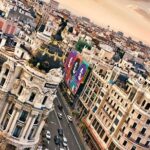
Finally, you’ll pass Gran Vía, one of Madrid’s main streets. It begins in Calle de Alcalá and ends at Plaza de España. Built in the early twentieth century, it’s a major marker for Madrid’s commercial, tourist, and leisure life.
This ending is smart because Gran Vía is where many people will later spend time on their own. Dropping you near it gives you an easy launch point.
The guide factor: speed is good, but people make it great
The best part of this kind of tour is how the guide turns fast stops into real meaning. I especially liked the mention of guides and drivers who lean into making the experience smooth and photo-friendly.
In the feedback you can see examples like a driver named Tadeo and a guide called Ángel (described as Venezuelan). Those details matter because they hint at a tour style where the guide is actively helping with pictures and extra context, not just reciting facts while you rush past.
One caution: don’t leave the language detail to chance. There’s at least one account where the guide didn’t match the booked language, and it turned into a faster, less satisfying experience. If English matters to you, I’d verify that preference before you go.
Is this tour good value for $215.07 per group?
For $215.07 per group up to 4, the value mostly comes from two things: private timing and compressed sightseeing.
You’re getting a guided ride across distinct Madrid areas—Centro landmarks, royal/palace zone, old-town plazas, and then the Salamanca-to-stadium corridor. If you tried to do this yourself with taxis plus walking plus finding entrances, you’d burn time and money fast.
It’s not a museum day. You won’t get long interior visits as part of the core deal, and Palacio Real admission isn’t included. But if what you want is to see the city quickly, understand what you’re looking at, and then spend your remaining days choosing where to linger, this price can feel fair.
Who should book this electric tuk tour
This works best if:
- You’re in Madrid for a short time and want a fast map of the city
- You prefer less walking and more planning-free sightseeing
- You want a private group outing (up to 4)
- You care about both classic landmarks and modern Madrid (Las Ventas, Bernabéu, and the financial district)
It might not fit if:
- You want long museum sessions and ticketed interior time
- You need a guaranteed language match no questions asked (double-check this)
Should you book this tour?
I’d book it if you’re the kind of traveler who likes to start with orientation. This route is built to show you how Madrid layers old royalty, political power, religious landmarks, and modern city life—without forcing you into a full-day hike.
Just go in with the right expectation: it’s a two-hour highlights ride. You’ll leave with great photo angles and context, then you can build your own deeper days around the places that hook you most.
If you’re strict about language and pickup timing, take a minute to confirm those details ahead of time. Do that, and this tour becomes an efficient, fun way to kick off Madrid right.
FAQ
How long is the tour?
It’s listed as about 2 hours.
What’s the price and group size?
The price is $215.07 per group, and it’s up to 4 people.
Is the tour in English?
Yes, it’s offered in English.
Where does the tour start and end?
It starts at Pl. de la Lealtad, 1, Retiro, 28014 Madrid, Spain and ends back at the meeting point.
What’s included in the price?
It includes GST (Goods and Services Tax), and you’ll receive a mobile ticket.
What’s not included?
Lunch, dinner, and the admission fee for Palacio Real are not included.
Is this a private tour?
Yes. It’s listed as a private tour/activity, so only your group participates.
Can I cancel for a full refund?
Yes. You can cancel up to 24 hours in advance for a full refund.