REVIEW · MADRID
Madrid Tuk Tuk Welcoming Tour
Book on GetYourGuide →Operated by Tuktuk Limo Tours · Bookable on GetYourGuide
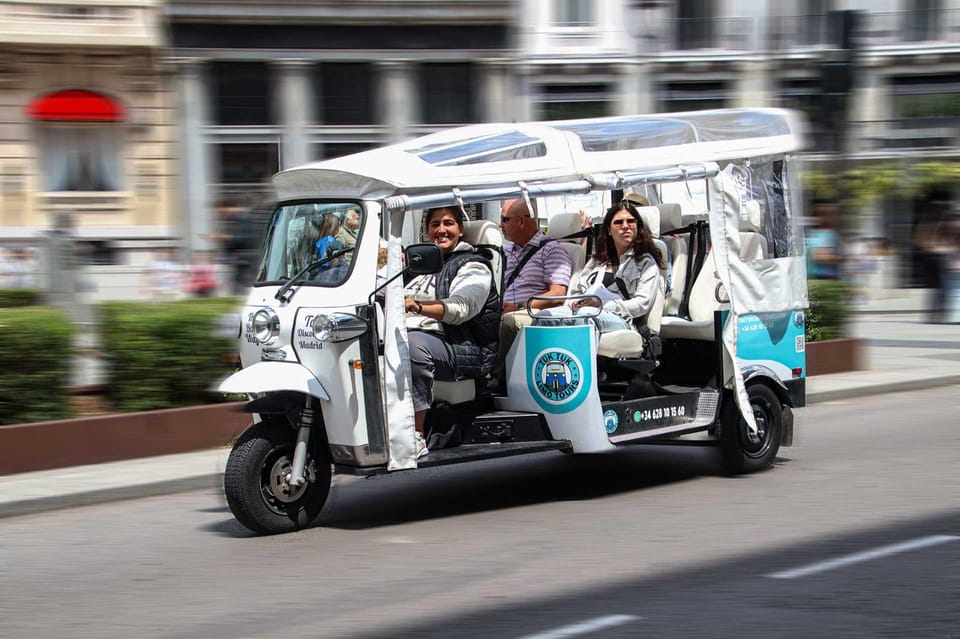
Madrid gets easier with a tuk tuk. In just 120 minutes, you glide between big sights and quieter corners, with photo stops built into the route and an electric ride that keeps the pace friendly. I like how the guide stories turn landmarks into people-and-dates moments, and how the stops are timed for quick photos. One thing to watch: language and audio can be inconsistent, so if you booked German and need clear narration, plan to double-check expectations before you go.
You’ll get a fast overview of Madrid’s personality, from markets and classic restaurants to royal grounds and football-and-bullfighting icons. I also like that the tour hits both old-town Madrid (Calle Mayor, Cava Baja, La Latina) and modern Madrid (Gran Vía, Castellana, Bernabéu) without making you jog between places.
Since it’s a private group up to 4 with an electric tuk tuk, it’s a smart option for couples, small families, and anyone who wants sightseeing without burning half the day on transit. If your group has trouble stepping up or getting in/out of vehicles, that’s a consideration with this kind of ride—so keep it in mind when you book.
In This Review
- Key things to know before you ride
- Tuk Tuk Fast-Track: Why 2 Hours Works in Madrid
- Meeting at Calle Mayor 90: Getting Started Smoothly
- Calle Mayor to San Miguel: Old Madrid, Photo-Ready Stops
- Botín (Founded 1725) and the Cava Baja Bar Streets
- La Latina to La Gate Views: Churches and the Puerta de Toledo
- Atocha and Retiro: Madrid’s Daily Pulse and Its Big Green Pause
- From Alcala Gate to Las Ventas: Madrid’s Grand Entrances
- Bernabéu, Castellana, and Gran Vía: Modern Madrid Without the Confusion
- Plaza de Callao to Plaza España: Theater Life and Cervantes Views
- Temple of Debod to the Royal Palace: Egypt to Royals in One Ride
- Ópera and Almudena Cathedral: The Area That Links Everything
- Price and Value: When $187 per Group Actually Makes Sense
- Guide Language and Audio: The One Detail Worth Planning For
- Getting In and Out of the Tuk Tuk: Small Steps, Real Differences
- Who Should Book This Tour (and Who Might Skip It)
- Should You Book Madrid Tuk Tuk Welcoming Tour?
- FAQ
- How much does the Madrid Tuk Tuk Welcoming Tour cost?
- How long is the tour?
- Where is the meeting point?
- What languages are available for the live guide?
- What are some of the main places you stop at?
- Is it a private group, and is it wheelchair accessible?
- What’s included in the price?
Key things to know before you ride
- 120 minutes with lots of photo stops, so you’re not stuck waiting at one crowded place.
- San Miguel Market + Sobrino de Botín give you a real taste of how Madrid eats.
- Retiro Park and the Royal Palace area show you the city’s “pretty side” fast.
- Atocha Station, Las Ventas, and Bernabéu add contrast: everyday Madrid meets spectacle Madrid.
- Two common friction points to plan around: language matching and whether you’ll hear the guide clearly.
Tuk Tuk Fast-Track: Why 2 Hours Works in Madrid
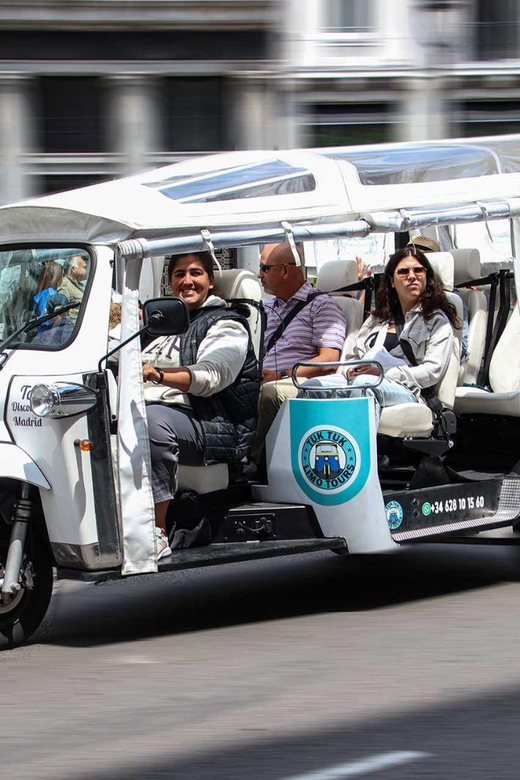
Madrid is a big city. Most first-timer plans either feel rushed on foot or feel incomplete if you only stick to one neighborhood. This tour hits the sweet spot: it’s short enough to keep energy up, but packed enough to give you a mental map of the capital.
The big advantage is movement. In two hours, you cover places that normally take longer because you’d be crossing traffic, walking extra blocks, and fighting parking. With an electric tuk tuk, you can look around with your head up, not buried in a phone map.
Also, the route is built for snapshots. The stops aren’t long sit-down visits; they’re timed breaks to look, photograph, and get the story behind what you’re seeing.
You can also read our reviews of more tours and experiences in Madrid.


Meeting at Calle Mayor 90: Getting Started Smoothly
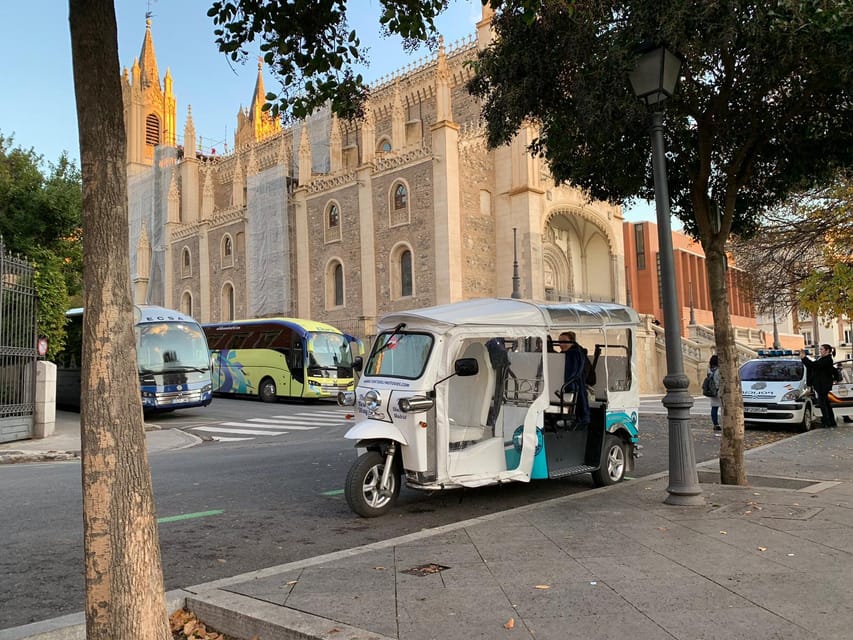
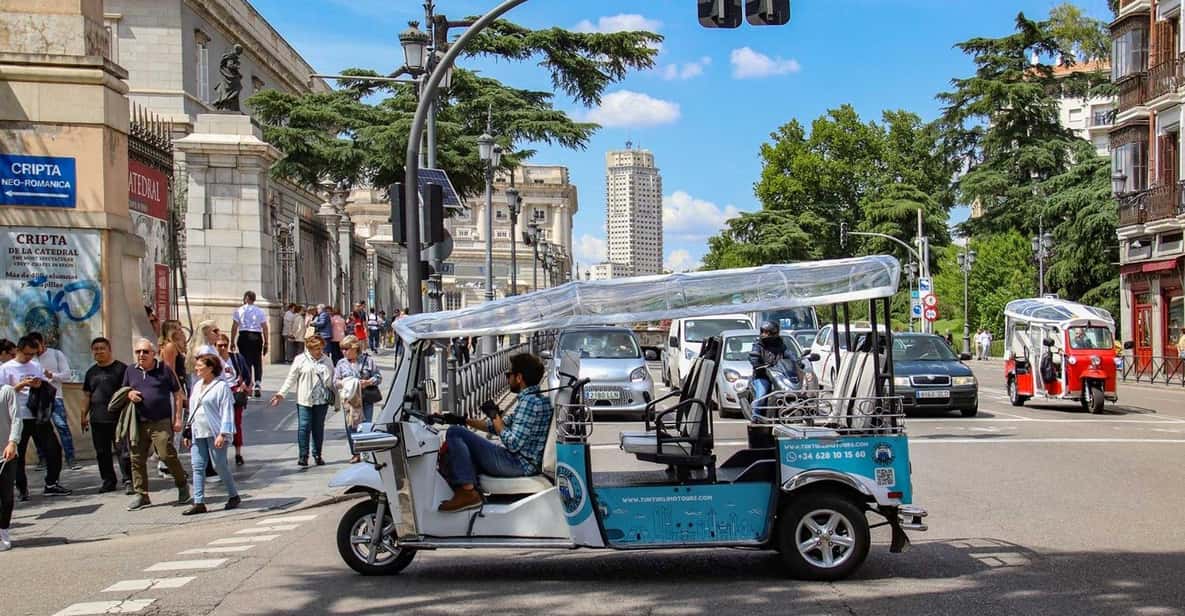
You start near C. Mayor 90 at the Cripta de Almudena area. Meet where you can find the Tuk Tuk Limo Tour branded tuk-tuks.
This matters because Madrid streets can be confusing the first time you’re there. Once you locate the vehicle, the ride becomes very straightforward: you’ll hop between photo-worthy corners, with the guide handling the pacing.
I recommend arriving a few minutes early, not because you’ll be rushed, but because you’ll want a calm moment to orient yourself. You’ll get more out of the stories when you can actually see the landmark while it’s being explained.
Calle Mayor to San Miguel: Old Madrid, Photo-Ready Stops
Your first taste of the historic core is Calle Mayor, a street with a heavy-hitter past. One highlight here is the connection to Pedro Calderón de la Barca, who lived there. Even if you don’t know the name offhand, it’s a classic Madrid “this is where culture grew up” moment.
Then you roll to Mercado de San Miguel, one of the most famous markets near Puerta del Sol. This is a great stop for visual context. You’ll understand why Sol feels like the city’s hub: it’s tied to Spain’s road network and the famous clock used to mark New Year’s.
If you like food scenes, this is more than a quick look. You’re seeing the kind of place locals and visitors associate with Madrid’s day-to-night energy. And since it’s built for photos, it’s easy to grab a couple of good shots without turning the market stop into a long detour.
Quick reality check: you won’t have time for a full meal on this tour. Treat it like orientation plus atmosphere. If you want tasting time, plan a separate food stop later.
Botín (Founded 1725) and the Cava Baja Bar Streets
Next up: Sobrino de Botín, famous for being associated with tradition since 1725. That “oldest” claim is the kind of fact that turns a simple exterior stop into a story you’ll remember. Even if you’re not dining there today, it’s a strong Madrid landmark because it connects the city to food and ritual.
After that, the route moves into Cava Baja, a neighborhood known today for bars and traditional restaurants. Historically, it’s tied to earlier Arab presence in the city, including the idea of a hideout. The point isn’t to turn it into a lecture—it’s to show how neighborhoods evolve. Same street energy, different eras.
Cava Baja is also a smart photo stop because you get layers: architecture, street life, and the modern bar culture that keeps the area alive at night. If your trip includes an evening out in Madrid, this stop helps you know where you might want to return.
La Latina to La Gate Views: Churches and the Puerta de Toledo
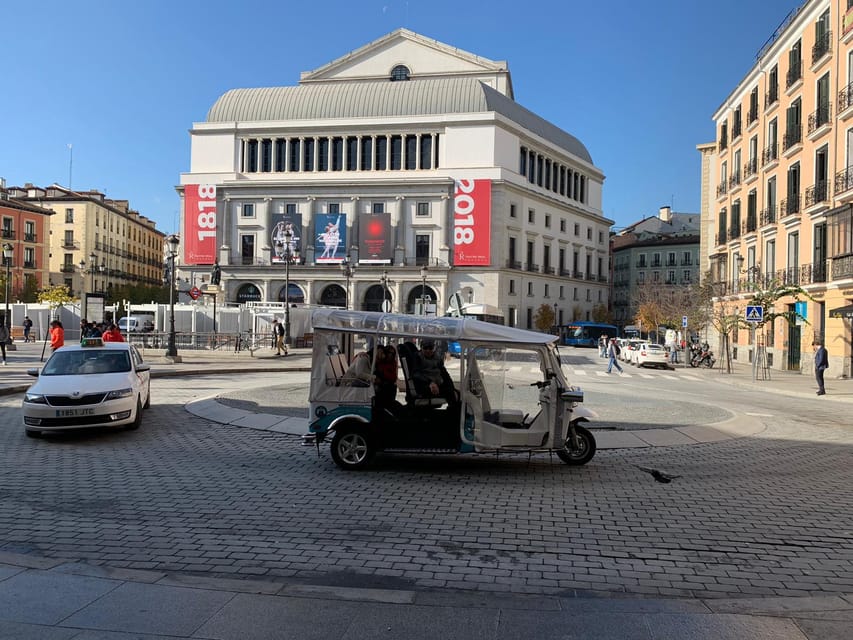
You’ll see Royal Basilica of San Francisco el Grande in La Latina. It’s a Roman Catholic church with a history reaching back to the 13th century, and it’s the kind of place where scale surprises you even from the outside.
The practical value of a church stop on a short tuk-tuk tour is context. Madrid’s big religious buildings shape where the city feels important—politically, socially, and culturally. You don’t need a long tour here to understand that.
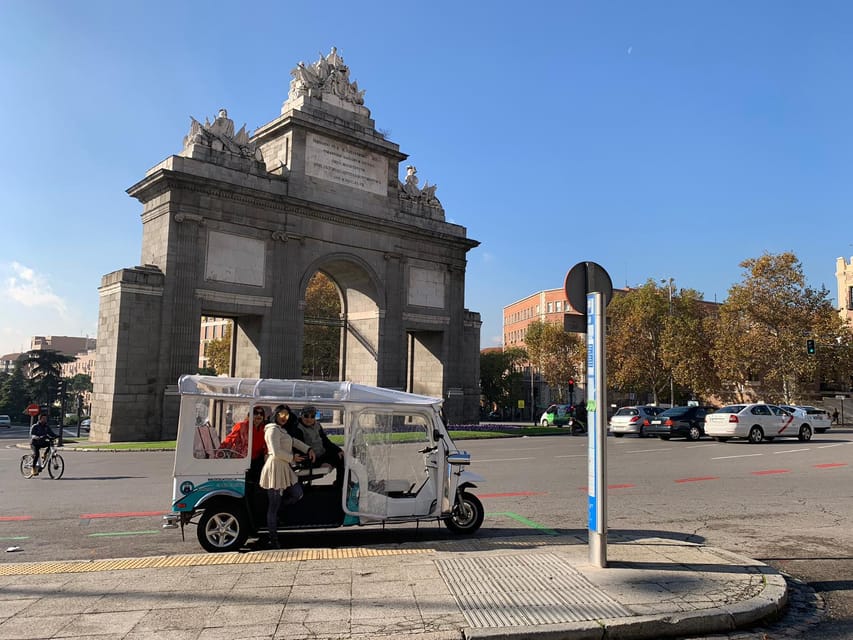
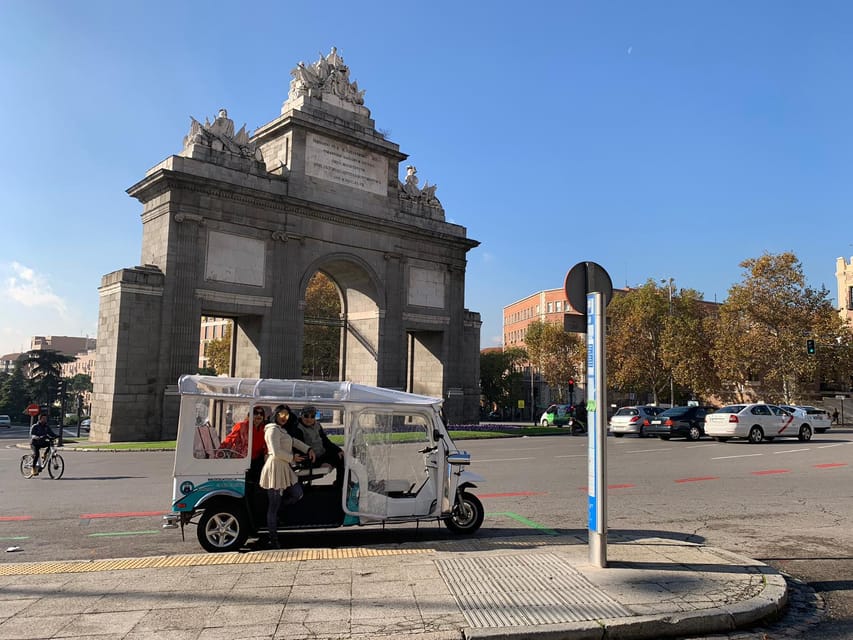
Then there’s a gate-and-view moment with Glorieta de Toledo and the Puerta de Toledo. The Puerta de Toledo is a monumental 19th-century gateway, and seeing it helps you connect Madrid’s older core to the city’s later expansion.
This is one of those stops that’s good for photos even if you’re not a “look at gates” person. It gives you a landmark with clear lines and a sense of place.



Atocha and Retiro: Madrid’s Daily Pulse and Its Big Green Pause
Next, you hit Atocha Station, and this one is genuinely useful. It’s one of Spain’s busiest hubs, with an estimate of 90 million passengers annually. Even if you’re not taking trains, seeing Atocha tells you how Madrid works: it’s a city built for movement.
Then the tour slows down in the best way with Buen Retiro Park. You’ll get a look at the pond area, monuments, and the Crystal Palace. The park is tied to the reigns of Philip IV and Charles III, which helps you understand why Retiro feels like more than just a park—it feels like a piece of royal and civic Madrid.
Here’s how to make Retiro count on a short stop: don’t try to cover it all. Pick one or two angles—pond and central monument lines, for example—then use the guide’s story to anchor what you’re looking at.
Retiro is also a good reset if you’ve been in the city center chaos earlier. The vibe changes fast, and you’ll feel it instantly.
From Alcala Gate to Las Ventas: Madrid’s Grand Entrances
After Retiro, you’ll see Alcalá Gate, erected in 1778. It used to be Madrid’s main entrance, near the park. That kind of detail helps you stop treating the city as a grid of places and start seeing it as a planned city with eras of growth.
From there, the tour swings into a completely different kind of landmark: Las Ventas Bullring. It’s widely considered one of the most important bullrings in the world, and the architecture makes the stop worthwhile. You get a sense of how deep tradition runs in Madrid—even if you don’t attend events.
This segment is useful for two types of travelers:
- If you want “icon Madrid” quickly, this delivers.
- If you’re curious about how Spain’s traditions show up in real urban space, it delivers context.
Bernabéu, Castellana, and Gran Vía: Modern Madrid Without the Confusion
Now you’re in the bigger, louder Madrid: Santiago Bernabéu Stadium for Real Madrid, home since 1947 and tied to major football history. Even if you’re not a die-hard fan, the scale hits you fast. It’s the kind of stop where you instantly understand why Madrid is famous beyond its museums.
Then comes Paseo de la Castellana, a major thoroughfare with historic mansions, and today it’s home to embassies and cultural institutions. You’ll also see the Museum of Public Art referenced in this area, which signals how Madrid layers contemporary culture over older grandeur.
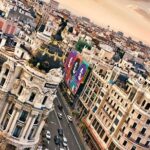
After that, you reach Gran Vía, the iconic avenue linked to Madrid’s modernization. It’s a good stop because it’s visible from multiple angles and feels unmistakably “city of the 20th century onward.”
Plaza de Callao to Plaza España: Theater Life and Cervantes Views
Gran Vía feeds into Plaza de Callao, described as the heart of Madrid’s cinematic and theatrical scene. The architecture here includes art deco details, so even a quick stop can produce good photos with strong lines and silhouettes.
Then you move to Plaza de España, where you’ll see the Cervantes Monument at the intersection of Gran Vía and Princesa streets. This is a solid photo stop because it’s readable in one glance. Even if you only spend a few minutes, it gives you an anchor point for later wandering.
If you plan your own walking afternoon, these squares are useful. They’re easy meeting points, easy orientation markers, and you can build routes outward from them.
Temple of Debod to the Royal Palace: Egypt to Royals in One Ride
One of the most surprising stops is Temple of Debod. It’s an ancient Egyptian temple from the 2nd century BC, relocated to Madrid in Cuartel de la Montaña Park. This is the kind of Madrid weird-in-a-good-way moment you can’t manufacture on your own without planning.
Then you get the center of royal imagery: the Royal Palace of Madrid. This palace was home to Spain’s kings and still serves as the official royal residence. The key here is visual comprehension. You don’t need interior access to understand what the palace represents.
Right after, there’s Plaza de Oriente, a pedestrian square next to the palace with gardens and statues. Even from a short stop, it helps you see how the palace sits within the city’s public space, not just as an isolated monument.
Ópera and Almudena Cathedral: The Area That Links Everything
You’ll pass through Ópera Station, located in Plaza de Isabel II. It’s a helpful transit reference because it ties to Teatro Real, Plaza de Oriente, and the Royal Palace area. For many travelers, that helps later when you’re trying to navigate Madrid without overthinking it.
Then the tour includes Catedral de Almudena, completed in 1993 after a long build with history reaching over a century. From the outside (and from nearby viewpoints), it’s the kind of stop that makes sense even if you’re not an architecture specialist.
If you’re the type who wants one grand cathedral moment during your trip, Almudena is a good choice in this short window.
Price and Value: When $187 per Group Actually Makes Sense
The price is $187 per group up to 4. That’s not cheap if you’re traveling solo, because you’ll likely pay the full group amount. But it becomes fair fast once you’re splitting with friends or family.
Here’s the math you can use:
- If 2 people go: about $93.50 per person
- If 4 people go: about $46.75 per person
For that per-person range, you’re paying for three things: an electric tuk-tuk ride, a live guide who connects the dots, and a route built around short photo stops across widely separated areas. In other words, you’re buying time and convenience.
It also includes insurance and skips the ticket line when it applies to the stops you’re visiting. Because many of the moments are photo stops, you avoid the usual time sink of waiting around, scanning lines, and losing momentum.
Guide Language and Audio: The One Detail Worth Planning For
There’s a theme worth taking seriously: language matching and audio clarity. Some guides have been reported as attentive and clear in explanations, with names like Miguel and Yonnathan mentioned in successful experiences. That’s a good sign for the storytelling side.
But there are also reports where the booked language didn’t match what the guide actually used, and where the tour audio was hard to hear even when turned up. I’d treat this as a practical heads-up: if language is crucial for you, you might want to confirm what you’re actually getting before you show up.
Also keep expectations realistic. This is a moving vehicle tour. If you’re relying on fine details, sit where you can hear best, and don’t plan to capture every word with audio—you’re here for the big-picture overview plus the visuals.
Getting In and Out of the Tuk Tuk: Small Steps, Real Differences
Another practical consideration: some groups find getting in and out of the tuk tuk a bit tricky depending on personal mobility and how you approach the vehicle. The tour is listed as wheelchair accessible, which is great, but vehicle-style access can still vary in how it feels day to day.
My advice: if you have someone in your group with mobility concerns, it’s smart to communicate needs clearly when you book. Don’t assume the experience will feel identical to a full-sized van.
Who Should Book This Tour (and Who Might Skip It)
This tuk tuk tour is a strong fit if:
- You want a 2-hour orientation to Madrid.
- You like photo stops and quick context without long walks.
- You’re traveling with a small group and want shared value.
It’s less ideal if:
- You need flawless language delivery and very high audio clarity for every sentence.
- You want deep, long museum-style visits. This is about getting the lay of the land, not lingering for hours.
If you’re visiting for the first time, this can be a great early-day plan because it helps you decide what to return to later. If you’ve been in Madrid already and you just need a highlight sweep, it can also work well.
Should You Book Madrid Tuk Tuk Welcoming Tour?
If you’re smart with your expectations, I think you’ll like it. The price makes most sense for groups up to 4, and the route covers the kind of spread that would take you much longer on foot: markets near Puerta del Sol, royal Madrid near Almudena and the palace, and major modern landmarks like Bernabéu and Gran Vía.
My decision checklist is simple:
- You’re okay with a fast stop rhythm rather than long visits.
- You want photo-friendly orientation plus guide storytelling.
- You’re willing to double-check language and audio needs ahead of time.
If those boxes fit you, this is a fun, efficient way to get oriented and start enjoying Madrid the rest of your trip.
FAQ
How much does the Madrid Tuk Tuk Welcoming Tour cost?
It costs $187 per group, up to 4 people.
How long is the tour?
The tour lasts 2 hours (120 minutes).
Where is the meeting point?
You meet at C. Mayor 90 (Cripta de Almudena, Madrid). Look for Tuk Tuk Limo Tour branded tuk-tuks.
What languages are available for the live guide?
The live guide is available in English, French, German, Italian, Portuguese, Slovenian, and Spanish.
What are some of the main places you stop at?
You’ll pass by or stop for photo opportunities at places including Calle Mayor, Market of San Miguel, Sobrino de Botín, Cava Baja, Royal Basilica of San Francisco el Grande, Atocha Station, Buen Retiro Park, Alcala Gate, Las Ventas, Santiago Bernabéu Stadium, Gran Vía, Plaza de España, Temple of Debod, the Royal Palace, Plaza de Oriente, Almudena Cathedral, and Ópera Station.
Is it a private group, and is it wheelchair accessible?
Yes. It’s listed as a private group, and it’s wheelchair accessible.
What’s included in the price?
The tour includes an electric tuk tuk, a driver/guide, insurance, and the guide’s stories. It also says skip the ticket line.