Segovia and Toledo feel like two different countries in one day. You start with the Roman aqueduct and end with the Alcázar views, then roll into Toledo’s three-cultures story—Jewish, Moorish, and Christian—while guides like Ofelia and Alejandra (mentioned in the best moments of the experience) bring the streets to life. The big win here is that it’s a structured day trip: you get the key sights without having to plan every turn.
There’s a lot to fit into about 11.5 hours, so the schedule can feel long, and the day can hinge on bus conditions and timing. I’d treat comfort as a “check before you relax” item: some groups reported great air-con and easy pace, while others hit delays or heat when the bus situation wasn’t ideal. If you’re sensitive to temperature or easily stressed by changes, build in a little extra patience.
In This Review
- Key things I’d zero in on
- Segovia’s Roman Aqueduct: the instant wow you get up front
- Alcázar of Segovia: a castle-palace that looks like a ship
- St Stephen’s Church in Segovia: the Romanesque bell tower moment
- Toledo’s three cultures route: where Jewish, Moorish, and Christian stories overlap
- San Juan de los Reyes monastery: royal memory in Isabelline style
- Toledo Cathedral and Santo Tomé: Gothic scale plus El Greco
- The long-day reality: how the schedule feels in practice
- Buses, air-con, and group size: what to plan around
- Value check: is the price fair for Segovia and Toledo from Madrid?
- Who this day trip fits best
- Should you book Segovia and Toledo in one day?
- FAQ
- Where does the tour start in Madrid?
- What time does the tour begin?
- How long is the trip?
- Is the tour offered in English?
- What’s included in the price?
- Are entrance tickets to museums or churches included?
- How big is the group?
- Is there free cancellation?
Key things I’d zero in on
- Segovia’s Roman aqueduct stop gives you that fast wow moment and a great photo angle right away.
- Alcázar setting: the bow-of-a-ship shape on its rocky crag makes the fortress feel instantly recognizable.
- Toledo’s three-cultures route connects the Synagogue of Santa María la Blanca, church conversions, and Gothic grandeur.
- El Greco art at Santo Tomé adds a modern anchor to all the medieval stone you’ll see.
- Guide quality varies by language mix and timing, with standout English guidance in several cases (Ofelia, Alejandra, Andrea, Angie, Ester, Alfredo).
- Bus comfort and delays can make or break the mood on a long day.
Segovia’s Roman Aqueduct: the instant wow you get up front
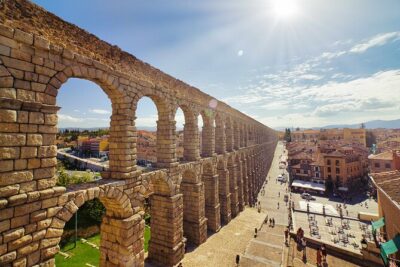
The day opens in Segovia with one of Spain’s best-known Roman sights: the Roman aqueduct, still standing and still doing its job in the imagination if not in the engineering sense. It’s tall, it’s dramatic, and it’s one of those landmarks that makes you stop walking even if you’re trying to keep pace.
What I like about starting here is simple: it gives you orientation fast. Once you’ve seen the aqueduct, Segovia’s geography clicks—you’re in a town with strong stone identity, and everything later (castle, churches, viewpoints) feels like it belongs to the same story.
Practical tip: wear shoes you trust. Segovia streets can be slick or steep depending on weather, and you’ll likely be on your feet for the walking portion before the next big stop. If you’re the type who likes to linger for photos, plan for a quick burst of extra time here—this is your anchor.
You can also read our reviews of more tours and experiences in Madrid.



Alcázar of Segovia: a castle-palace that looks like a ship
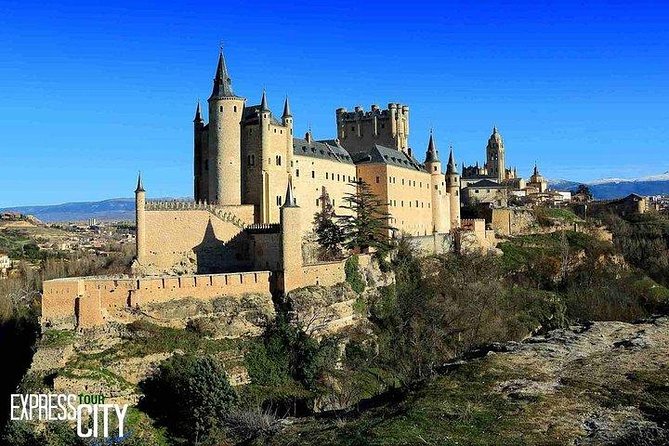
Then comes the star shape: the Alcázar of Segovia, a medieval castle-palace that rises on a rocky crag near two rivers. The most memorable detail is how it reads in your eyes: the fortress silhouette looks like the bow of a ship, which is exactly why it’s such a distinctive icon.
Even if you don’t spend ages inside, you’ll get value from the outside setting and the guide’s framing. The Alcázar has worn multiple roles over time: fortress, royal palace, state prison, and later military college and academy. Today it’s used as a museum and military archives building, so you get that layered “power building” feeling without needing extra imagination.
One consideration: this is a popular site, and with time tight, access to interiors may not match your expectations. Some people mentioned trouble getting inside key spaces (like the Segovia cathedral), so I’d treat major interiors as something to try, not something to assume.
St Stephen’s Church in Segovia: the Romanesque bell tower moment
Segovia also includes a medieval church stop: the Church of St Stephen. It dates from the 12th century and is especially noted for its Romanesque bell tower. It’s not the flashiest stop on the list, but it’s the kind of place that helps you understand how Segovia’s style differs from Toledo’s grand Gothic mode.
This is a good “pause” stop. When your brain is overloaded from big landmarks, a smaller church moment can feel like a reset: you see the details, you hear the guide’s explanation, and you take a breath before the bigger Toledo moves.
If you like architecture, keep your camera handy—but also keep your eyes up. Bell towers are easy to photograph well when you catch the angle from the street instead of only from the main approach.
Toledo’s three cultures route: where Jewish, Moorish, and Christian stories overlap
Now for Toledo—the city that feels built on history layers. This part of the experience is designed around the long coexistence of Jewish, Moorish, and Christian communities, and it shows in the specific stops you’ll see.
The centerpiece early on is the Synagogue of Santa María la Blanca, originally known as the Ibn Shushan Synagogue. It was erected in 1180 (based on an inscription) and is often described as the oldest synagogue building in Europe still standing—though that claim is described as disputable. Today it functions as a museum and former synagogue, and ownership/preservation is connected to the Catholic Church. That blend matters: you’re not just touring a building, you’re seeing how later eras re-framed earlier spaces.
What I like here is the perspective shift. Toledo isn’t “one story.” It’s a set of overlapping stories, and the guide’s job is to point out where they collide and where they stayed visible.
Consideration: because Toledo is hilly and walking-intensive, you’ll want to stay steady and pace yourself. If you’re prone to fatigue, save your big energy for the Cathedral and the El Greco stop later.
San Juan de los Reyes monastery: royal memory in Isabelline style
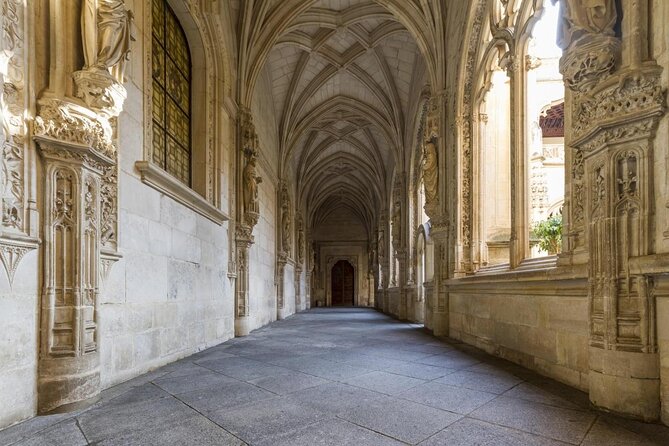
Next you hit the Monastery of San Juan de los Reyes, an Isabelline-style monastery built in the 15th century. It was founded by Ferdinand II of Aragon and Isabella I of Castile to commemorate both the birth of their son, Prince John, and their victory at the Battle of Toro (1476) over Afonso V of Portugal.
This stop gives you more than pretty stone. It’s a reminder that many major buildings in Spain aren’t only artistic—they’re political. The monastery’s purpose links it directly to dynastic ambition and religious legitimacy, which helps you read Toledo beyond tourism photos.
Practical tip: if the sun is strong, this is a place to take shade breaks when they appear. Monastery exteriors often mean open-air walking and then short interior moments, so heat management matters.






Toledo Cathedral and Santo Tomé: Gothic scale plus El Greco
Toledo’s big Gothic moment is the Primate Cathedral of Saint Mary of Toledo, the seat of the Metropolitan Archdiocese of Toledo. The Cathedral is one of Spain’s 13th-century High Gothic cathedrals, and some authorities consider it the Gothic masterpiece of Spain.
When you stand in the Cathedral’s orbit, you feel why Gothic style became a whole language here. Even when you only get a short guided look, you can see the Cathedral is meant to grow upward and pull your attention into the building’s structure.
Then, the tour moves to the Church of Santo Tomé. This church was founded after the reconquest by King Alfonso VI of León, built on the site of an older 11th-century mosque. In other words, the building story includes continuity as well as change—mosque elements were repurposed into Christian use with no major destruction.
And then you get the pop-art moment from medieval devotion: you can admire El Greco’s The Burial of the Count of Orgaz here. That painting gives you a bridge between the medieval architecture around it and the emotional intensity that modern visitors often feel immediately.
One caution: some people said they didn’t have enough time to get into certain interiors. For the Cathedral area and Santo Tomé, timing matters. If you care most about interior viewing, keep your pace tight and don’t let side conversations slow you down too much.
The long-day reality: how the schedule feels in practice
This is an all-in-one day trip: pick-up in Madrid at 9:00 am and about 11 hours 30 minutes total, with the tour ending back at the same meeting point. That’s a full day, and the walking portions in both cities are real.
I think it works best when you treat it like a “great hits” sampler. You’ll see major landmarks like the aqueduct, the Alcázar, the Synagogue of Santa María la Blanca, the monastery, Toledo Cathedral, and Santo Tomé—then you’ll go home with a solid mental map of why each city matters.
But if you want slow meals, long interior time, and wandering without timers, the day can feel rushed. Several comments echoed this: people wanted more time to explore, and some felt Toledo navigation on their own got confusing when they had less structured time.
So here’s my advice: go in with priorities. Decide ahead what you’ll fight for—Aqueduct photos, Alcázar views, Cathedral interior, or El Greco—and let the rest be “nice to see,” not must-see heartbreak.
Buses, air-con, and group size: what to plan around
The tour runs by high-end round-trip bus from Madrid to Segovia and Toledo, with the group capped at 55 travelers. In theory, that size is workable for guided walks. In practice, group logistics can be the swing factor between an enjoyable day and a stressful one.
The best experiences included comfortable seats, working air conditioning, and smooth driving—plus guides who managed crowd flow well. Other experiences flagged problems: limited legroom, bus changes, and air-conditioning trouble in hot conditions.
This matters because Toledo and Segovia are weather-sensitive. When the bus is late or the air-con fails, the discomfort stacks on top of already-long walking time.
My practical checklist for you:
- Bring a bottle of water and sun protection if you’re traveling in warm months.
- Expect potential timing shifts; keep a calm brain and don’t assume every stop will run like a metronome.
- If you’re traveling with kids or you’re heat-sensitive, think twice about how you’d handle a delay.
Value check: is the price fair for Segovia and Toledo from Madrid?
At $77.06 per person, the value comes from packaging: you’re paying for the bus transfer plus bilingual guided walking tours in Segovia and Toledo. If you’ve ever tried to plan a Segovia-and-Toledo day alone, you know the hardest part isn’t knowing the names of sights—it’s managing transport, timing, and where to stand for the best views.
This price looks especially fair if:
- you want a guided structure,
- you prefer not to figure out city flow,
- and you’re happy with a “see the essentials” pace.
Where value can drop is when your personal priorities require more time inside major sites. Some people mentioned trouble getting into certain interiors and felt the day didn’t leave enough breathing room. If that’s you—if you want deep cathedral time and long museum time—two separate days can feel more satisfying than squeezing everything into one.
Who this day trip fits best
This tour fits you if you want a confident overview and you like guided storytelling more than self-guided wandering. It’s also a strong pick if you’re new to the region and want to understand the medieval layering in both cities: Roman engineering in Segovia, and then Toledo’s three-cultures overlap, Gothic scale, and El Greco.
It might frustrate you if:
- you hate long days and heavy walking,
- you’re very strict about interior access time,
- or you need consistently great air-conditioning and zero schedule changes.
If you can swing it, I often recommend planning extra time in at least one city. Even when a one-day trip is enjoyable, the places earn repeat visits.
Should you book Segovia and Toledo in one day?
I’d book it if your goal is a high-value overview with guided help in English and you’re okay with a tight schedule. The best parts—like the aqueduct-first start and the mix of Toledo’s synagogue-to-cathedral-to-El Greco path—are exactly the kind of “you’ll be glad you did this” route that’s hard to replicate smoothly on your own.
I’d also book it only if you accept one reality: this is still a long bus day. If you’re heat-sensitive or easily stressed by delays, you’ll want to mentally prepare for comfort being variable and for some stops to feel time-pressured.
FAQ
Where does the tour start in Madrid?
It starts at C. de San Bernardo, 5, Centro, 28013 Madrid, Spain.
What time does the tour begin?
The start time is 9:00 am.
How long is the trip?
It runs about 11 hours 30 minutes (approx.).
Is the tour offered in English?
Yes. The tour is offered with bilingual English and Spanish guided walking tours in both Segovia and Toledo.
What’s included in the price?
Included are round-trip transport by high-end bus from Madrid to Segovia and Toledo, plus bilingual guided walking tours in Segovia and Toledo, with a mobile ticket.
Are entrance tickets to museums or churches included?
The tour details don’t specifically say that site entrance tickets are included, and it’s possible you may need to handle entry for certain interiors.
How big is the group?
The maximum group size is 55 travelers.
Is there free cancellation?
Yes, free cancellation is available up to 24 hours in advance for a full refund.
###