REVIEW · MADRID
Escape the Inquisition in Madrid Exploration Game
Book on Viator →Operated by Questo · Bookable on Viator
A creepy theme, but it’s light on chaos. This self-guided Escape game in central Madrid turns street corners into puzzle stops, with offline play and no need to sync with a human guide. You follow clues, solve mini-brain-teasers, and each stop points you to the next location while teaching you about what you’re standing near.
Two things I really like: the schedule freedom (you can start any hour and take breaks whenever you want), and the fact it’s private with no human contact, so you can avoid the crowd shuffle that often ruins sightseeing. One thing to keep in mind: because it’s puzzle-based, difficulty can vary by group—some puzzles may feel too easy for younger kids, while some adult groups may find certain clues frustrating without extra time or help.
In This Review
- Key Things to Know Before You Play
- Madrid Without the Usual Sightseeing Script
- The Starting Point: C. de San Bernardo Setup and Timing
- How the Game Flow Feels at Each Stop
- Stop-by-Stop: From Calle de San Bernardo to the Finish
- Stop 1: Calle de San Bernardo (C. de San Bernardo)
- Stop 2: Calle de Isabel la Católica
- Stop 3: Tribunal del Santo Oficio de la Inquisición
- Stop 4: Plaza Mayor
- Stop 5: Mercado San Miguel
- Stop 6: Plaza de la Cruz Verde
- Stop 7: Restaurante La Muralla
- Stop 8: Placa de la Cebada
- Stop 9: Real Basilica de San Francisco el Grande
- Price and Value: Why This Costs Just $7.14
- The Real Strength: Flexibility and Avoiding Crowds
- Who Will Enjoy This Most (and Who Might Fight It)
- Practical Tips So You Don’t Waste Time
- Should You Book Escape the Inquisition in Madrid?
- FAQ
- How long does Escape the Inquisition in Madrid take?
- Where does the game start and where does it end?
- Can I start at any time during the day?
- Does it work offline?
- Is it offered in English?
- Is there a physical tour guide with you?
- Are entry tickets included for the stops?
- Is the tour refundable?
- Is this experience private?
Key Things to Know Before You Play
- No guide waiting for you: it’s phone-led, and you get instructions via email rather than meeting a staff member on-site
- Offline friendly: you can play without an internet connection
- Flexible timing: start within daily opening hours and pause/resume as needed
- Short, punchy stops: each location is designed for about 5–10 minutes before you move on
- Free-entry stops on the route: the listed stops are marked as admission ticket free
- Private group format: only your group participates, with group discounts available
Madrid Without the Usual Sightseeing Script
Most Madrid sightseeing tours are about timing. This one is about solving. You’re not herded into a bus window view or marched from monument to monument. Instead, you walk at your own speed through central streets, and the game tells you where to go next through clues and puzzle steps.
The Inquisition theme gives the walk an edge. Even if you’re not a history superfan, the framing makes you look closer. You stop at specific places—like the Tribunal del Santo Oficio de la Inquisición—and you get prompts that push you to notice details you might otherwise walk right past.
And because it’s designed as a self-guided experience, you’re not stuck in someone else’s pace. That matters in Madrid, where one missed connection of energy—too hot, too tired, or a kid bored—can derail the whole day. Here, you can pause and resume whenever you want.
You can also read our reviews of more tours and experiences in Madrid



The Starting Point: C. de San Bernardo Setup and Timing

Your starting address is C. de San Bernardo, 1, Centro, 28013 Madrid. Your end point is Calle de la Ventosa, 21, Centro, 28005 Madrid. You’ll find this route sits squarely in central Madrid, which is handy because you’re near public transportation and you can loop back into the rest of your day easily.
A key logistics point: this is not a “stand here and wait for your guide” situation. It’s a private, phone-based game, and the guidance is provided through your smartphone using instructions sent via email. If you arrive expecting a person to meet you with a briefing, you might end up standing there longer than you planned. Plan to start by following the instructions you already received, not by waiting for a pickup.
Daily opening hours run from 5:00 AM to 9:30 PM, and the game is described as available to book 24/7 every day. In practice, that means you can fit it into an early morning stroll or a later afternoon break—especially useful if you’re juggling kids, mobility needs, or a day that already has museum plans.
How the Game Flow Feels at Each Stop

At every location, the pattern repeats: you follow a clue, arrive at a named spot, and then solve a puzzle. After that, you get indications on how to continue, plus learning material tied to what you discovered.
That repetition is a feature, not a flaw. It keeps the walk moving without needing to constantly reorient yourself like you would with a do-it-yourself map route. You’re not guessing where to go next; you’re just solving your way there.
Also, the time windows are tight. Most stops are designed around 5 minutes, with the Tribunal del Santo Oficio de la Inquisición listed at about 10 minutes. This keeps the game from turning into an all-day production. You should still expect some “human delay” moments—slower reading, group debate, or the classic wait, what did that clue mean?—but the structure helps.
Stop-by-Stop: From Calle de San Bernardo to the Finish
Stop 1: Calle de San Bernardo (C. de San Bernardo)
You start at C. de San Bernardo, 1 and begin with a clue hunt that leads you to this first location. Once you’re there, you solve a puzzle to unlock the next step, and you also get quick learning prompts tied to the place you’ve found.
Why this stop works: it sets the rhythm. If your group can figure out how the puzzles “talk,” the rest of the game usually feels easier to manage. It’s also a nice low-pressure warm-up—no big detours right away.






Stop 2: Calle de Isabel la Católica
Next you follow another clue to Calle de Isabel la Católica. The puzzle step again drives you forward, and you get indications for where to go next, plus learning content tied to what you’ve discovered.
This is the stage where I’d suggest keeping the group focused. If you have kids, ask them to solve the first part, then you take over the second part. In a puzzle game, shared roles stop the whole thing from becoming one person staring at a phone while everyone else waits.
Stop 3: Tribunal del Santo Oficio de la Inquisición
This is your longer stop at about 10 minutes, and it’s the one with the most emotionally charged name: Tribunal del Santo Oficio de la Inquisición. You still follow the clue, solve the puzzle, and receive instructions onward—but the learning portion is tied to this location.
Even if you’re skeptical of “themed” history, this stop gives you a reason to slow down. Names like this don’t belong to a generic city walk. You’ll likely find yourself reading more carefully than you would on a standard route.
One more practical note: because this is the longer step, it’s also where the game can feel harder or more time-consuming for some groups. If you’re running behind, don’t worry—your ability to pause and resume can save your day.
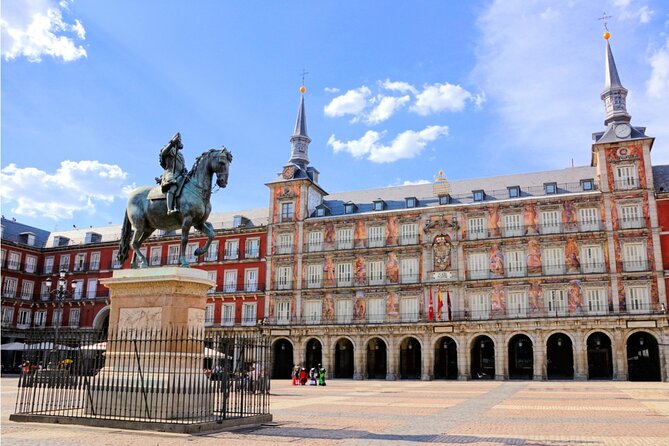
Stop 4: Plaza Mayor
You move on to Plaza Mayor, another short stop around 5 minutes. The clue leads you in, you solve the puzzle, and the game points you forward again.
Plaza Mayor is one of those Madrid anchors. Even if you’ve been there before, the puzzle wrapper gives you a reason to look at it from the angles the game expects, rather than from the tourist-photo angles you’d normally default to.
Stop 5: Mercado San Miguel
Next is Mercado San Miguel, about 5 minutes listed. Same cycle: clue, puzzle, learn, continue.
This is a smart inclusion for value. A market stop means you’re near a place where you can grab a snack if you’re doing this as part of a longer outing. The game itself keeps things light and short, so you can add food time without breaking the whole schedule.
Stop 6: Plaza de la Cruz Verde
Then you’re guided to Plaza de la Cruz Verde for another quick 5-minute puzzle step. You get indications for what’s next, plus learning tied to the spot.
Short plaza stops are useful in a walking game. They break up the streets so you don’t feel like you’re going nonstop. If you have mixed ages in your group, these short beats help keep energy up.
Stop 7: Restaurante La Muralla
You’ll also reach Restaurante La Muralla as a stop (listed around 5 minutes). The game still follows the same clue-and-puzzle pattern and offers learning along the way.
If you’re wondering how a restaurant becomes part of a walking game: often it’s used as a “landmark puzzle location.” That’s good news—you don’t need to pay for anything here just because it’s a restaurant name on the map.
Stop 8: Placa de la Cebada
Next is Placa de la Cebada (again listed at about 5 minutes). You follow the clue, solve the puzzle, and receive next-step instructions.
This is where I’d expect the game to feel most “street-level.” It’s not just famous monuments—you’re playing around neighborhood Madrid details, which often makes self-guided walks more memorable than checklist sightseeing.
Stop 9: Real Basilica de San Francisco el Grande
Finally, the walk heads to Real Basilica de San Francisco el Grande for the last stop, listed about 5 minutes.
End points in puzzle games matter. If your day is already packed, you’ll appreciate that the game finishes without requiring extra backtracking. Plus, ending near a major landmark gives you a natural “wrap-up moment” where you can decide whether to continue exploring in that area.
Price and Value: Why This Costs Just $7.14
At $7.14 per person, this is priced like a budget-friendly activity—but what makes it feel like real value is how flexible it is.
For that price, you’re getting:
- a private, self-guided city experience (so no wasted time waiting for others)
- phone-led offline play
- a structured route through central Madrid
- multiple puzzle steps that keep you moving without a human escort
In other words, you’re not paying for a long formal guided lecture. You’re paying for a built-in game format that helps you explore. If you’re the type of traveler who likes to wander with a goal, this can be a strong deal.
If you’re the type who hates puzzles or prefers straightforward guided explanations, the price might not translate to value for you. That’s not a judgment—it’s just about match.
The Real Strength: Flexibility and Avoiding Crowds

The listing emphasizes full flexibility: you can start any hour, take a break at any time, and resume later. That’s the practical superpower here.
Madrid days can go sideways fast. A sudden rain shower, a long lunch, a kid melting down, or simply “we need a coffee first” can derail rigid tours. With this game, you can stop whenever life happens and jump back in.
The other big strength is the approach described as private and with no human contact. That means fewer friction points: no meeting-time stress, no group pacing fights, no crowd pressing. You still share the public spaces with other people, of course—but the activity itself doesn’t turn into a herd.
Who Will Enjoy This Most (and Who Might Fight It)
This experience is described as ideal for adventurous travelers, families, and groups. That checks out for the “type of fun” it provides: walking with a challenge and learning prompts built into the route.
Here’s what to consider based on the range of puzzle experiences you might run into:
- If you’re traveling with kids: some groups may find the puzzle steps quite straightforward, while others might hit moments where reading or clue interpretation slows everything down. Plan to help with interpretation, not every single step.
- If you’re a solo adult or a couple: you may finish faster, but you might also run into clues that feel more wordplay-y than logic-y. Give yourself enough time to re-read the prompt.
- If you have a mixed group of different ages: you’ll likely do best by assigning roles—one person reads prompts, another tries the puzzle, and someone else watches the clock so you don’t lose the thread.
Because the game is self-guided, it can’t respond to your group dynamically the way a human guide would. If your group needs constant reassurance, you may prefer a traditional tour.
Practical Tips So You Don’t Waste Time
A few pieces of practical advice will make a big difference:
- Start from the instructions, not from expectation. There isn’t a physical pickup indicated. Use your email instructions to begin.
- Bring patience for puzzles. This is not a “press play and walk” experience. If you rush, you’ll get stuck.
- Wear shoes you can trust. The route is within central Madrid and structured in short hops, but you’ll still be walking city distances.
- Use break time strategically. If you pause halfway, you can avoid the common failure mode: getting tired, then trying to force puzzle progress while your brain is done.
- Plan for language support. It’s offered in English, so if your group prefers English prompts, you’re set.
Should You Book Escape the Inquisition in Madrid?
Yes, I’d book it if you want a low-pressure, puzzle-powered walk through central Madrid and you like having your schedule in your hands. The price is small, the format is flexible, and the offline-friendly setup is a real win if you’re worried about connectivity.
I’d think twice if your group hates puzzles, or if you know you’ll be upset by a self-guided setup with no physical guide on-site. Also, if your group spans ages very unevenly, plan for a bit of role-sharing so nobody gets stuck doing all the thinking.
If you want Madrid in a more playful format—one that turns the city into a game board—this is an easy yes.
FAQ
How long does Escape the Inquisition in Madrid take?
It’s listed as about 1 hour 10 minutes.
Where does the game start and where does it end?
It starts at C. de San Bernardo, 1, Centro, 28013 Madrid and ends at Calle de la Ventosa, 21, Centro, 28005 Madrid.
Can I start at any time during the day?
You can start at any hour, and the opening hours are listed as 5:00 AM to 9:30 PM.
Does it work offline?
Yes. You can play offline and don’t need an internet connection.
Is it offered in English?
Yes, the game is offered in English.
Is there a physical tour guide with you?
No. It’s a private, self-guided city game with instructions provided through your smartphone, and it is described as avoiding human contact.
Are entry tickets included for the stops?
The listed stops are marked as admission ticket free in the itinerary information, and no separate admission is indicated.
Is the tour refundable?
Yes. Free cancellation is available up to 24 hours in advance for a full refund.
Is this experience private?
Yes. It’s described as private, meaning only your group participates. Service animals are allowed.