REVIEW · MADRID
Madrid Insolite En Français : Hors des Sentiers Battus
Book on GetYourGuide →Operated by Madrid Pour Vous · Bookable on GetYourGuide
Madrid without the usual noise feels like a side door.
This French-led walk is built for La Latina and northern Lavapiés, where you’ll see everyday streets, small squares, and old church facades without bouncing from one famous landmark to the next. You start at Puerta Cerrada and end back there, with a route that mixes well-known names with calmer corners.
I love how the experience stays personal: small groups of up to 10, or you can go private, and the pace can bend to the group. I also love the guide talent. I’ve heard standout performances from guides like Leire, who speaks crisp French and answers every question, and Abdul, who shows the kind of spots you’d miss on your own.
The main thing to consider is simple: it’s a 2-hour walking tour, so you’ll want comfortable shoes and a willingness to go at street level, with plenty of stopping for stories. Also, the tour won’t run if the minimum of 4 participants isn’t met, so plan with flexibility.
In This Review
- Key things I’d circle before booking
- Puerta Cerrada start: the easiest way to get oriented fast
- La Latina and northern Lavapiés: two textures of local Madrid
- Basilica of San Miguel to Plaza de la Paja: building the story block by block
- Plaza de Puerta de Moros and Church of San Andrés: when the route turns practical
- Rastro Flea Market on Sunday mornings: local energy in street form
- Lavapiés highlights: Calle Embajadores, San Cayetano, and Pavón Theatre
- What you’ll actually get from the guide (and why it affects your day)
- Price and value: why around $40 makes sense for 2 hours here
- Who this tour is best for (and who should skip it)
- FAQ
- FAQ
- What language is the tour guide?
- How long is the walking tour?
- Where do I meet, and where does it end?
- Is the tour a small group or private?
- Is the tour wheelchair accessible?
- What happens if there are not enough participants?
- Should you book this walk?
Key things I’d circle before booking
- Up to 10 people or a private tour, so you actually hear the guide and can ask questions
- French-language guiding, with reported strong performance from guides like Leire
- La Latina + northern Lavapiés, not just one neighborhood
- A route that blends plazas, churches, and street scenes, then adds the Rastro market on Sunday mornings
- Back-to-start convenience, meeting at Puerta Cerrada Square next to the big cross
Puerta Cerrada start: the easiest way to get oriented fast
You’ll meet at Puerta Cerrada Square, right next to the big cross. That’s a smart setup because it gives you a clear “anchor point” from the first minute, especially on a 2-hour schedule. And since the walk ends back at the same meeting point, you’re not left figuring out transit or backtracking afterward.
The route is designed for a short, satisfying loop: enough time to connect the dots between older streets and local life, without wearing you out. Think of it as a Madrid warm-up that also works as a real sightseeing experience, not just a neighborhood stroll.
You can also read our reviews of more tours and experiences in Madrid.


La Latina and northern Lavapiés: two textures of local Madrid
This tour focuses on La Latina and the northern part of Lavapiés, two areas with strong street character and plenty of architectural variety. What you get is contrast. La Latina tends to feel like classic old-city Madrid in its layout and plaza energy, while Lavapiés brings a more everyday, neighborhood rhythm.
What makes this valuable for you is that you’re not just touring buildings. You’re walking the in-between spaces: narrow streets, small squares, and the kind of corners where locals pass through without turning it into a performance. That’s where the “how Madrid actually feels” part comes from.
Basilica of San Miguel to Plaza de la Paja: building the story block by block
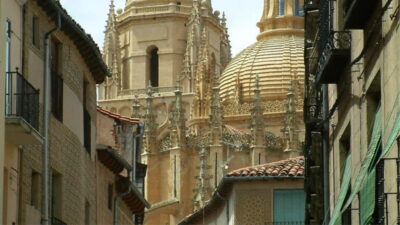
You begin at the Basilica of San Miguel, a natural starting point because it sets a tone right away: religion, community landmarks, and the older layers of the city all in one. From there, the walk threads through Plaza de la Cruz Verde and Plaza de la Paja. Plazas are small on paper, but on foot they become major stages. They’re where the guide can tie street names and locations into a bigger explanation.
You’ll also pass by the Church of San Pedro el Viejo. Stops like this matter because churches in central Madrid often act like history markers in the landscape. You’re not just seeing a facade; you’re getting the why behind its place in the neighborhood walk.
Practical note: these are frequent “pause and look” moments. You’ll be glad the tour is built for a small group size, since it helps everyone keep up without feeling rushed.
Plaza de Puerta de Moros and Church of San Andrés: when the route turns practical
Next you head toward Plaza de Puerta de Moros and the Church of San Andrés. This is the part of the walk where the route starts to feel like a map, not a checklist. The guide’s job here is to help you understand how these points relate to one another so that, when you leave, you can picture the neighborhood beyond the day’s path.
On the way, you’ll pass the Museum of San Isidro. Even if museums aren’t your main goal, the presence of a museum along a walking route adds texture. It signals that this area isn’t just for passing through—it’s a place where culture and identity are part of the everyday streetscape.
If you like tours that explain what you’re seeing rather than just naming it, this section is where you’ll feel it.
Rastro Flea Market on Sunday mornings: local energy in street form
Then the walk brings you to the Rastro Flea Market, described as where the local spirit comes alive on Sunday mornings. This stop is a big reason to book, because it shifts the tone from architecture to life-in-motion.
Even without turning this into a shopping spree, it’s the kind of environment that helps you understand a neighborhood quickly. You’ll see how a market shapes the flow of streets and the way people move through an area. It’s also a good contrast to the earlier church-and-plaza rhythm—same neighborhood logic, different form of activity.
If your schedule lines up, this is the “Madrid feels real” moment many people remember.






Lavapiés highlights: Calle Embajadores, San Cayetano, and Pavón Theatre
After Rastro, you spend time in Lavapiés with stops that help you catch the neighborhood’s identity in different ways.
You’ll walk Calle Embajadores, which works as a visual spine for the area: a street that gives you a sense of scale and movement. Then you’ll visit the Church of San Cayetano, another landmark stop that reinforces how places of worship still function as recognizable points for locals.
Finally, you’ll see the Pavón Theatre. Including a theater matters because it adds the cultural layer beyond the historic and religious markers. You’re looking at how different “public spaces” shape a neighborhood day-to-day.
One of the strengths here is that the tour doesn’t treat these places as separate islands. You get a sense of how a neighborhood holds multiple functions at once: worship, performance, daily walking routes, and the market energy that ties it together.
What you’ll actually get from the guide (and why it affects your day)
The guide quality is a top selling point for this tour, based on what I’ve heard about past walks. Leire is singled out for being friendly, speaking perfect French, adapting to everyone’s pace, and answering questions with real enthusiasm. Abdul is also noted for strong, understandable guiding in English, and for showing places people wouldn’t find alone.
Now, you might be thinking: is this just “nice commentary”? Not exactly. On a route like this, the guide is what turns the street names into a mental map. When the guide connects the places, you finish the walk with more than photos. You leave with context.
Also, the tour is described as respectful tourism, which you’ll feel in the way the group moves and how questions are handled. When you can ask things and the guide responds, the whole experience becomes more yours, not just theirs.
Price and value: why around $40 makes sense for 2 hours here
At $40 per person for a 2-hour walking tour, you’re paying for a few things that add up fast:
- A live, French-speaking guide who keeps the walk flowing and answers questions
- A short route with intentional stops across La Latina and northern Lavapiés
- Small group sizing (max 10) or an option for private touring
- A customized itinerary, which usually means the guide can keep the route matched to the group
If you were to do this on your own, you’d likely spend more time figuring out where to go and when to stop. With a guided walk, the value comes from efficiency and context. You don’t just see places. You learn how they connect.
In other words, the price isn’t only for walking. It’s for turning that walking into understanding.
Who this tour is best for (and who should skip it)
This is a strong fit if you:
- Want authentic-feeling Madrid without sticking to the busiest tourist circuit
- Prefer small groups where you can ask questions
- Like neighborhoods where the streets do half the storytelling
- Enjoy history explanations tied to places you can actually walk to
You might want to choose something else if you:
- Hate walking for 2 hours with frequent stops
- Want a big, top-sights-only highlights package
- Are traveling on a date where the minimum group size might not be met (since the tour won’t run without at least 4 participants)
FAQ
FAQ
What language is the tour guide?
The tour is guided in French.
How long is the walking tour?
It lasts about 2 hours.
Where do I meet, and where does it end?
You meet at Puerta Cerrada Square next to the big cross, and the tour ends back at the same meeting point.
Is the tour a small group or private?
Small group tours are available, and private tours are also offered. The small group is limited to a maximum of 10.
Is the tour wheelchair accessible?
Yes, the tour is listed as wheelchair accessible.
What happens if there are not enough participants?
The tour won’t run without a minimum of 4 participants. If that minimum isn’t met, you’ll be offered an alternative date or a full refund.
Should you book this walk?
If you want Madrid that feels lived-in rather than staged, I’d book it. The mix of La Latina, northern Lavapiés, and a market stop at Rastro on Sunday mornings gives you variety in a tight 2-hour window. Add the small-group setup and strong French guiding from people like Leire, and you get a tour that’s easy to enjoy and actually useful for learning your way around.
Just be realistic about the pace: bring comfortable shoes, because you’re choosing a walking tour, not a ride-and-sit checklist. If that sounds like your style, this is one of the better ways to experience the city without spending your day in crowds.