REVIEW · MADRID
Big Bus Madrid Panoramic City Tour
Book on Viator →Operated by Big Bus Madrid · Bookable on Viator
Madrid lights look better from a double-decker. This Big Bus ride strings together the places you’d otherwise sprint between, with live narration in English and Spanish. I love the fast overview of Madrid’s core sights plus neighborhoods like Lavapiés, Chueca, and Malasaña, all without burning hours in transit. I also like that it’s built for skyline-and-squares views on an open-top bus. The big catch: the upper deck can be noisy and wind can make the guide harder to hear, so sitting downstairs is smart if you care about every word.
This tour is a single evening loop that lasts about 1 hour 20 minutes, starting at 8:00 pm and ending back near where you started. It’s aimed at seeing a lot in one go, not doing a hop-on hop-off wandering plan. The bus maxes out at 15 travelers, so it feels more like a compact guided outing than a huge mass event.
You’ll roll past famous landmarks and also quieter cultural spots that many first-day itineraries skip, from the Royal Palace area to the Parque del Retiro edge. Along the way, you’ll also get panoramic looks at major museums like the Prado and Reina Sofía from the street, plus major stations and city squares that help you understand how Madrid actually works.
In This Review
- Key things to know before you ride
- A quick way to see Madrid’s big hits in 80 minutes
- Where the tour starts: Neptune Fountain in Centro
- Open-top night views: how to get the best sightlines and sound
- Your panoramic route: Plaza Mayor to Puerta de Alcalá
- Cibeles Fountain, Royal Palace exteriors, and Temple of Debod at dusk
- Prado area and the culture spine: Plaza Colón, Prado, and Atocha
- Reina Sofía, Lavapiés, and Biblioteca Nacional: museum streets plus real neighborhoods
- Gran Vía, Chueca, and Malasaña: the city’s youth-and-night corridors
- Paseo del Prado, San Francisco el Grande, and Almudena Cathedral
- Retiro, Las Ventas, Serrano: parks, sport culture, and upscale Madrid edges
- Thyssen-Bornemisza and the final landmarks loop
- Price and value check: does $28.83 make sense?
- Guide quality matters: your best-seat strategy for clearer narration
- Should you book this Big Bus Madrid Panoramic City Tour?
- FAQ
- What time does the Big Bus Madrid Panoramic City Tour start?
- How long is the tour?
- Where do I meet for the tour?
- What languages are available on the bus?
- Is admission to the Royal Palace of Madrid included?
- How many people are on the tour?
Key things to know before you ride
- A night-friendly route that targets iconic streets and viewpoints in roughly 80 minutes
- Live guide in English and Spanish, so you’re not stuck with pre-recorded stops
- Open-top views come with audio tradeoffs, especially upstairs in wind and traffic noise
- You get panoramas, not long museum visits, including no Royal Palace ticket
- Small group size (max 15) makes the ride feel calmer than typical bus tours
A quick way to see Madrid’s big hits in 80 minutes
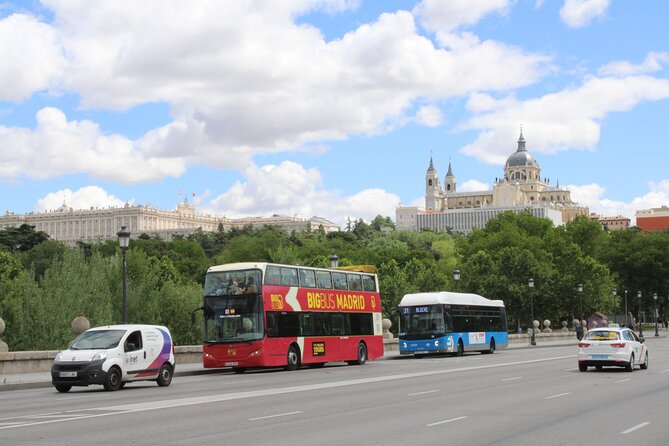
This is a practical tour for your first evening in Madrid or for a return trip when you want an efficient refresher. The whole point is time-saving: you get a guided look at many of the city’s most recognizable landmarks in one loop. At about 1 hour 20 minutes, it fits neatly between dinner plans and whatever night wandering you still want to do afterward.
Because the focus is panoramic sightseeing, you’re not paying for separate timed entry into multiple buildings. Instead, you’re paying for orientation: where things are, how the neighborhoods connect, and which sights are worth your attention the next day. If your day itinerary is already heavy, this kind of guided “viewing pass” can be a lifesaver.
You can also read our reviews of more city tours in Madrid



Where the tour starts: Neptune Fountain in Centro
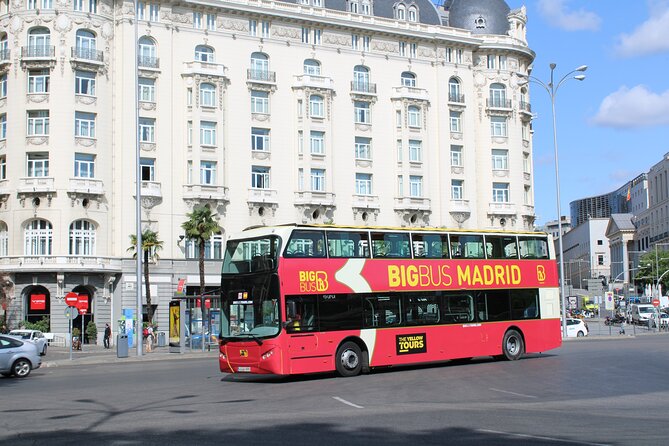
You meet at Neptune Fountain (Pl. Canovas del Castillo, s/n, Centro, 28014 Madrid). That’s a handy anchor point because it’s in the central zone, and it’s easy to pair this with nearby dinner options. The tour starts at 8:00 pm, so you’re catching Madrid as it shifts into evening mode.
The ending is back at the meeting point, which keeps the whole thing simple. In practice, that means you can plan your walk from a known spot rather than guessing how far you’ll end up.
Open-top night views: how to get the best sightlines and sound
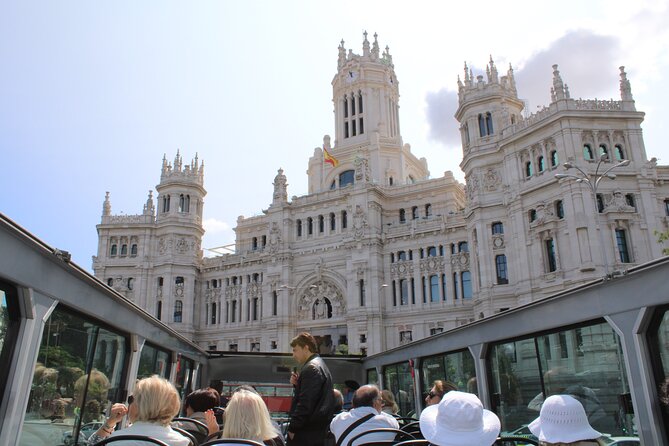
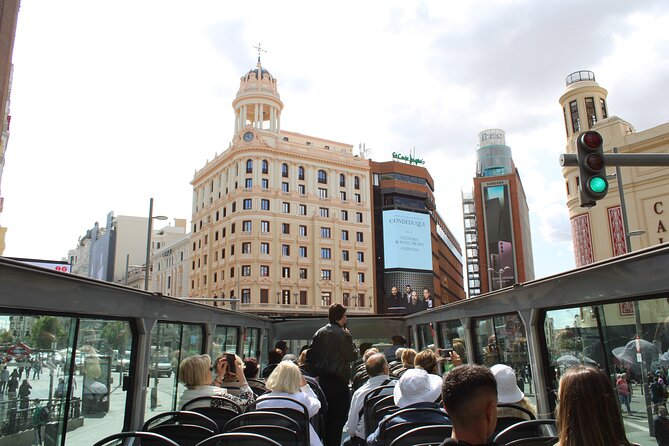
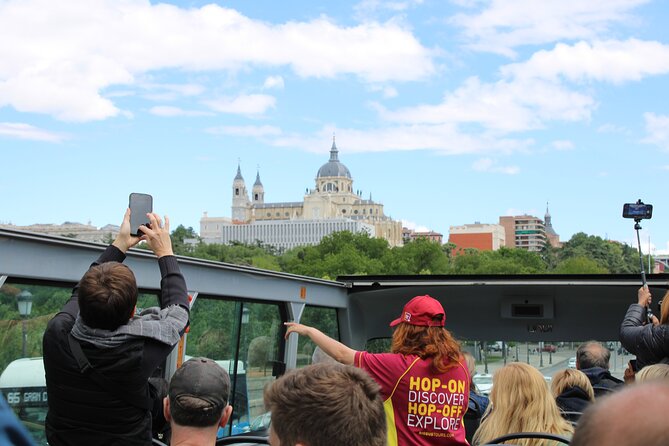
The bus is an open-top double decker, which is great for photos and wide angles of squares, boulevards, and domes. On a clear night, the viewpoints can feel especially dramatic because the skyline is less washed out than midday.
Now the practical part: the commentary is live, but the upper deck can be hard for audio in real-world conditions. Wind and traffic noise can swallow softer details, and several experiences highlight that you may miss parts of the guide’s narration from upstairs. My suggestion is simple: if you care about understanding the story, aim for the downstairs seats.
Also, don’t expect perfect photo conditions at every sight. If you’ve ever tried to shoot through moving bus vibrations, you know it’s not always smooth. Bring patience, use quick bursts, and focus on the big silhouettes and street-level context.
Your panoramic route: Plaza Mayor to Puerta de Alcalá
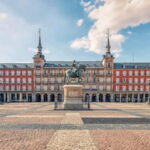
The ride begins with a look toward Plaza Mayor, a central stage for Madrid’s public life. From the bus, you get a sense of scale and the shape of the square without needing to fight for a specific corner. Even if you don’t go inside anything, this view helps you understand why this area is such a magnet for visitors.
Next you’ll get a panoramic shot of Puerta de Alcalá—the famous neoclassical gate that reads as Madrid’s formal entrance. It’s one of those landmarks that helps you orient your mental map instantly. If you’ve seen it on posters, this is where it becomes real.
As you continue, you’ll also pass the view of Plaza de Cibeles, a major hub where multiple big streets and architectural statements intersect. Think of it as the “Madrid crossroads” feeling, where the city’s grandeur shows up on the skyline as much as it does at street level.
Cibeles Fountain, Royal Palace exteriors, and Temple of Debod at dusk
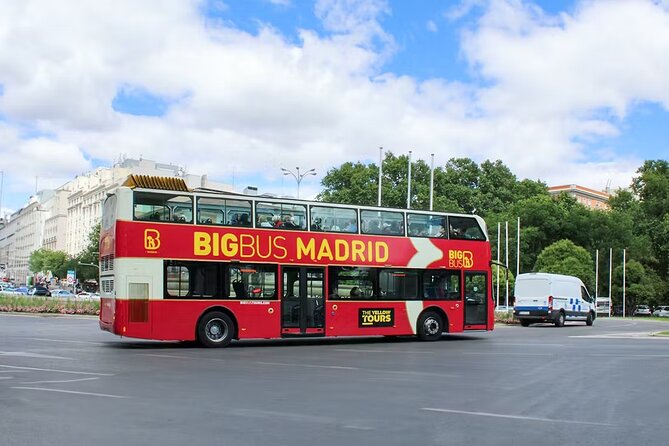
One of the ride’s strengths is variety: you’re not only seeing squares and gates, you’re also seeing the city’s power points. You’ll get a panoramic view of Cibeles Fountain as well, which works as a visual anchor because it’s so recognizable from a distance.
Then comes the big one: a panoramic view of the Royal Palace of Madrid. This is the catch for budget planning—your ticket covers the bus tour and the views, but Royal Palace admission is not included. In other words, you can admire the exterior from the street, but if you want to go in, you’ll need your own entry ticket plan.
Later, you’ll pass Templo de Debod, one of Madrid’s more surprising sights from a panoramic perspective. It’s not the kind of building you stumble into by accident, and seeing it from the bus gives you a strong reason to come back on a calmer schedule. Night lighting can make it feel even more distinct against the surrounding streets.




Prado area and the culture spine: Plaza Colón, Prado, and Atocha
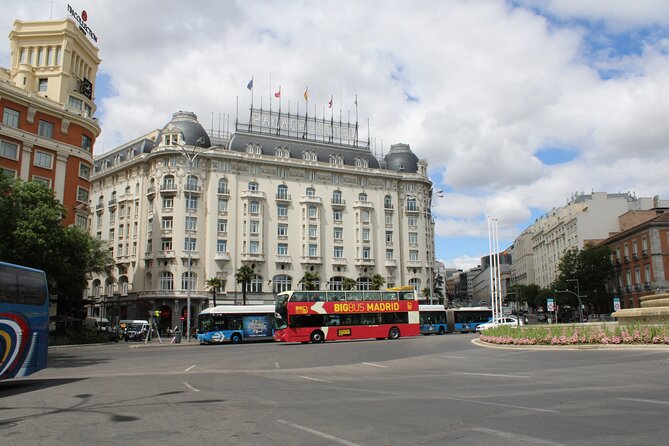
After Debod, the route keeps building a cultural spine. You’ll see Plaza Colón and Plaza de España, two areas that help explain how Madrid mixes grand monuments with everyday traffic flow. These are good stops to recognize when you later try to connect neighborhoods by foot or transit.
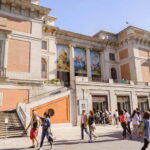
Then you move into the Museo del Prado area with a panoramic view of the Prado National Museum. You’re seeing it from the outside, but that’s still useful: you’ll understand the museum’s placement in relation to the surrounding boulevards and streets. If you love art, this is the kind of sightline that makes you want to schedule an actual visit next.
You’ll also pass Real Jardín Botánico, which gives Madrid a softer, more thoughtful side beyond the heavy monuments. From a bus, you’re mainly getting location and vibe, but that’s exactly what you want on an intro night.
A key transit moment appears with Atocha Station. Even without getting out, seeing the station from the bus helps you grasp how Madrid’s rail connections feed into the city center. It’s also a useful landmark for building your next-day plans.
Reina Sofía, Lavapiés, and Biblioteca Nacional: museum streets plus real neighborhoods
You’ll get a panoramic view of the Reina Sofía Museum. From the street, it’s a strong cue for anyone interested in modern art, and it helps you decide whether the museum belongs on your next-day itinerary.
Next comes a shift from major institutions to living neighborhoods with a panoramic view of Lavapies. This area tends to feel more everyday and multicultural than the biggest monuments zones. Even from the bus, you can start to sense that it’s a place to wander on foot rather than a place you just photograph.
Then you’ll see Biblioteca Nacional de España from the bus. A library might not sound like “must-see” sightseeing, but its presence matters because it signals the city’s intellectual center. Plus, it’s the kind of landmark that gives you more options later for a calm afternoon stop.
Gran Vía, Chueca, and Malasaña: the city’s youth-and-night corridors
This is where your panoramic tour turns into a map lesson. You’ll get a panoramic view of Gran Via, Madrid’s famous wide boulevard lined with shops and energy. Seeing it from the bus helps you understand why it anchors so many plans—this is the spine you end up crossing even when you didn’t mean to.
Then you’ll pick up neighborhood views that many people wish they had room for on Day 1:
- Chueca, known for its lively social scene
- Malasaña, a classic area for bars and street culture
You’re not getting a guided walking tour here, but you are getting orientation. If you later want to choose between dinner in an atmosphere-forward neighborhood or sightseeing near the museums, these views help you decide faster.
Paseo del Prado, San Francisco el Grande, and Almudena Cathedral
The route includes Paseo del Prado, a grand boulevard that connects some of Madrid’s most important institutions and viewpoints. This stretch is a big part of why the city feels “organized” even when it’s busy: it’s a clear axis.
After that, you’ll pass the panoramic view of the Basilica of San Francisco el Grande, one of the city’s standout religious buildings. Seeing its exterior from the bus is a good reminder of how much dome and silhouette matter in Madrid’s skyline.
Then you’ll get a view of Almudena Cathedral, which adds a more formal, cathedral-style presence to the skyline. Together, these two stops help you understand that Madrid doesn’t only do big civic monuments; it also invests heavily in sacred architecture that shapes the skyline.
Retiro, Las Ventas, Serrano: parks, sport culture, and upscale Madrid edges
Next up is the panoramic view of Parque del Retiro. This is a smart inclusion because it reminds you Madrid isn’t just stone buildings and squares. Even from a moving bus, you can grasp that the city has breathing room.
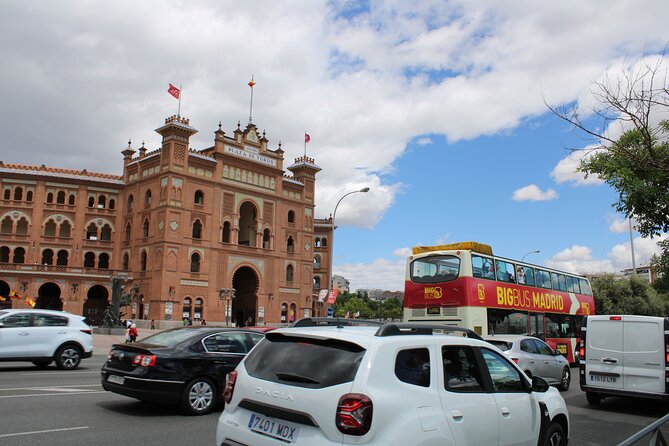
You’ll then see Las Ventas bullring, a cultural landmark that tells you Madrid has deep roots in traditions that aren’t only museum-based. If you’re the kind of traveler who likes to understand a city’s modern identity and its older customs at the same time, this stop is useful.
The tour also passes the neighborhood view of Serrano, which tends to feel like Madrid’s more upscale side. From the bus, you’re really learning where that vibe sits relative to the monument zones.
Thyssen-Bornemisza and the final landmarks loop
Toward the later part of the ride, you’ll get a panoramic view of the Museum of Thyssen-Bornemisza. Like the other museums on the route, you’ll be seeing it from the street, but that still helps you plan if you want to choose a museum that matches your interests.
Finally, you’ll return through major viewpoint moments, including Cibeles Fountain again and Paseo del Prado. That repeat isn’t a problem; it often means the route is looping through the city’s strongest visual corridors. The result is a ride that feels like a full-circle orientation rather than a straight line.
Price and value check: does $28.83 make sense?
At $28.83 per person for about 1 hour 20 minutes, you’re paying for a guided panoramic overview with an open-top bus and live interpretation in English (with the guide also covering Spanish). The inclusion set is clear: you’re getting the sights and the guiding, plus a mobile ticket.
The value question depends on your travel style:
- If you want a quick orientation to major sights and neighborhoods without walking all over, this is a strong value.
- If you’re hoping for big, time-consuming entry tickets across multiple buildings, you’ll likely feel limited, since the Royal Palace admission is not included and you’re mostly seeing exteriors and viewpoints.
- If you hate the idea of being in traffic and on a moving bus, you might feel like this is just paying to pass by things you could have reached on foot.
One more value factor: the tour is typically booked about 26 days in advance on average. That suggests demand is real in peak seasons, so planning a slot early can help you avoid last-minute scramble.
Guide quality matters: your best-seat strategy for clearer narration
Live guides are a big reason these bus tours work, and the experiences connected to this one show a wide range of guide styles and clarity. Some guides are described as funny and very informative, and others highlight that accents or microphone conditions made it harder to catch the narration.
Here’s how to stack the odds in your favor:
- If you want the best chance to hear every detail, sit downstairs.
- If you’re mostly chasing views, upstairs is where you’ll enjoy the sightlines, just accept that sound can be imperfect.
- Be ready for minor route changes. If streets get tight due to city events or roadblocks, you may not see every segment exactly as planned.
If your Spanish and English ears are selective, don’t stress: the presence of English-and-Spanish live commentary is still a major upgrade compared with audio-only tours.
Should you book this Big Bus Madrid Panoramic City Tour?
I’d book it if you’re entering Madrid and want a guided “big picture” night plan with minimal effort. It’s especially good for first-timers, travelers who feel their feet after a long day, and anyone who likes learning by seeing the city’s main monuments and neighborhoods in one sweep.
I’d skip or rethink if your priority is museum entry tickets and long stops. This tour is built for panoramic views, and you’ll still need separate plans if you want to actually go inside places like the Royal Palace.
FAQ
What time does the Big Bus Madrid Panoramic City Tour start?
The start time listed is 8:00 pm.
How long is the tour?
The duration is approximately 1 hour 20 minutes.
Where do I meet for the tour?
The meeting point is Neptune Fountain, Pl. Canovas del Castillo, s/n, Centro, 28014 Madrid, Spain.
What languages are available on the bus?
The tour is offered in English, and the live guide provides commentary in English & Spanish.
Is admission to the Royal Palace of Madrid included?
No. The Royal Palace of Madrid admission fee is not included.
How many people are on the tour?
The tour has a maximum of 15 travelers.