REVIEW · MADRID
Alcala de Henares and Cervantes Guided Tour from Madrid
Book on Viator →Operated by Fun and Tickets · Bookable on Viator
Cervantes’ story feels close up here. This half-day trip takes you from Madrid by air-conditioned bus into Alcala de Henares, with a guided walk and entry into the big Cervantes stops. You’ll get a real sense of how this town shaped Spain’s most famous writer, not just a quick photo loop.
I especially like that the format mixes two flavors: city-center strolling plus ticketed monument time. You also get strong context around Miguel de Cervantes and the educational power of the University of Alcala, including the Colegio de San Ildefonso.
One consideration: the schedule is tight (about 5 hours) and the day involves walking between stops. If you’re sensitive to timing, keep a little cushion in your plans for the way the pickup/drop-off points work.
In This Review
- Key highlights worth marking on your calendar
- Why Alcala de Henares feels like more than a quick day trip
- Price and value: what $54.57 buys you in real terms
- Getting there: bus comfort, mobile tickets, and the group size limit
- Plaza de Cervantes: start in the main square where the town frames Cervantes
- Colegio de San Ildefonso: the University of Alcalá you’ll remember
- Calle Mayor: a medieval shopping spine with deeper roots
- Museo Casa Natal de Cervantes: birthplace debate, then museum detail
- Catedral de Alcala de Henares: the political and social core in one place
- How the guide changes the whole day: Vicky, David, and Maria Jesús
- What to do before and after: lunch, timing, and the Mercado Cervantino chance
- Should you book this Cervantes day tour?
- FAQ
- How long is the Alcala de Henares and Cervantes guided tour from Madrid?
- What’s included in the price?
- Is food included during the tour?
- Do I need a face mask?
- How big is the group?
- Can I cancel for a refund?
Key highlights worth marking on your calendar
- Cervantes birthplace museum, with a real backstory about how the site was identified
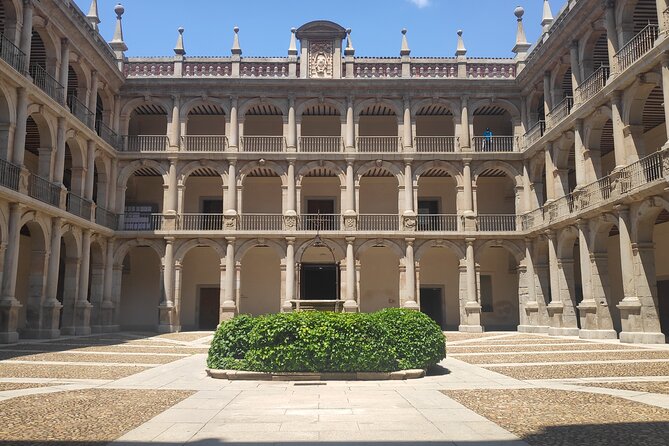
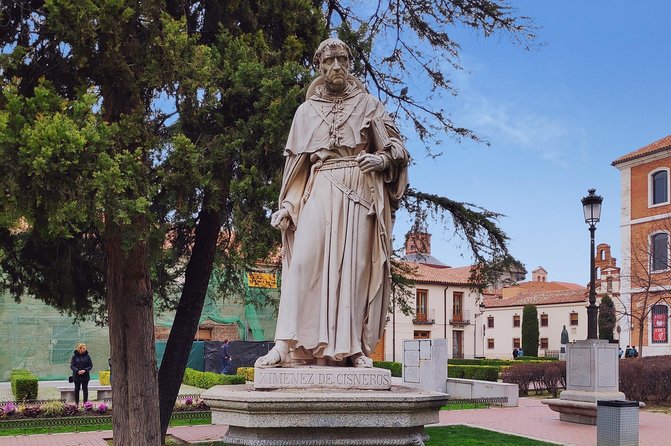
- College of San Ildefonso and the University of Alcala, tied to Cardinal Cisneros
- Calle Mayor’s medieval street plan, linked to the old Jewish aljama and Roman routes
- Guided walking plus admissions at major sites, not just outside viewing
- Small-group feel with a maximum of 50 people and possible multilingual guidance
- A cathedral visit in the old center, even though its entry isn’t included
Why Alcala de Henares feels like more than a quick day trip
Alcala de Henares is the kind of place where a short visit can still feel meaningful. It’s compact enough to tour on foot, but it carries heavyweight culture—especially through the University of Alcalá.
The Cervantes angle matters too. You’re not just seeing one famous address; you’re tracing how a town becomes a character in a writer’s life. And since the tour is built as a walking itinerary inside the historic core, the day doesn’t feel like you’re always in transit.
I also like that the tour’s focus is “Cervantes plus the institutions around him.” That means you’re seeing how education and city life were connected in the 1500s. Even if you know Cervantes from Don Quixote, you’ll likely come away with a fresh view of the man and the world around him.
You can also read our reviews of more guided tours in Madrid

Price and value: what $54.57 buys you in real terms
At about $54.57 per person for a ~5-hour outing, the best way to judge value is by what’s included beyond the guide.
This tour covers round-trip transport by air-conditioned bus, plus the walking guide, plus entry tickets for the University of Alcalá stop (Colegio de San Ildefonso) and the Museo Casa Natal de Cervantes. On top of that, several major city points along the route are free to view (like Plaza de Cervantes and Calle Mayor), so your paid time mostly goes into the ticketed interiors where it counts.
Food is not included, so you’ll want to plan a snack or budget for lunch on your own. But if you’re the type who likes to avoid separate lines and ticket decisions, this package-style structure is a big part of the value.
Getting there: bus comfort, mobile tickets, and the group size limit
You ride an air-conditioned bus, which is a practical win in Madrid’s warmer stretches. The tour runs with a maximum of 50 people, so you shouldn’t feel swallowed by crowds during the walking portion.
You’ll also receive a mobile ticket, which keeps check-in simple. The guide can be multilingual in some cases, so if you’re traveling outside Spanish, it’s worth checking the language option when you book.
One small-but-important note: face masks are mandatory during the tour. If you forget one, you can buy a mask during the tour for €1. Bring one if you can—less hassle, and you won’t have to factor in a purchase at the start.
Finally, pay attention to how pickup/drop-off points are handled. A few people reported that getting from the bus to the exact meeting point can involve some extra walking if the handoff happens slightly differently than expected. It’s not a dealbreaker, but it’s smart to be flexible.
Plaza de Cervantes: start in the main square where the town frames Cervantes
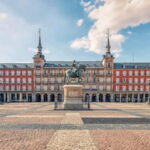
Your first stop is Plaza de Cervantes, around 30 minutes. This square has worn different names through history: it began as the Market Square, later became the Constitution Square, and since 1879 it has been Plaza de Cervantes in memory of Miguel de Cervantes.
It also works as a useful orientation point. Plaza de Cervantes is described as the main and largest square in Alcala de Henares, so once you’re here, the rest of the historic center starts to make more sense.
What you’ll take from this stop isn’t just the name on the sign. It’s the way the town puts Cervantes into everyday civic space. Even before you step into any museum, you feel the town’s identity is tied to his legacy.
It’s a lighter start, so if you’re arriving with energy, this is a good moment to get oriented and mentally map the route you’ll walk next.
Colegio de San Ildefonso: the University of Alcalá you’ll remember
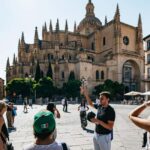
Next comes Colegio de San Ildefonso, about 45 minutes, with admission included. This is part of the University of Alcalá complex, connected to the Rector and designed as a core piece of the university structure created by Cardinal Cisneros starting in 1499.
The building’s facade was constructed starting in 1537, with architect Rodrigo Gil de Hontañón—known for cathedral work in Salamanca and Segovia—and it was finished in 1553. If you like architecture, this stop rewards you because you’re not just looking at “old walls.” You’re seeing how planning, teaching, and design all got treated as part of the same project.
The patio area connected to the school’s traditions is part of the experience too, including the Patio de Santo Tomas de Villanueva, along with spaces referred to as the Philosopher and the trilingual. The tour description also notes the Auditorium and the University Chapel as key areas.
A strong reason to care: the University of Alcalá isn’t a background detail here. It’s one of the cultural engines that explains how ideas circulated in Cervantes’ world. People who love history tend to leave this portion especially impressed because it’s where the educational side of Alcala becomes tangible.




Calle Mayor: a medieval shopping spine with deeper roots
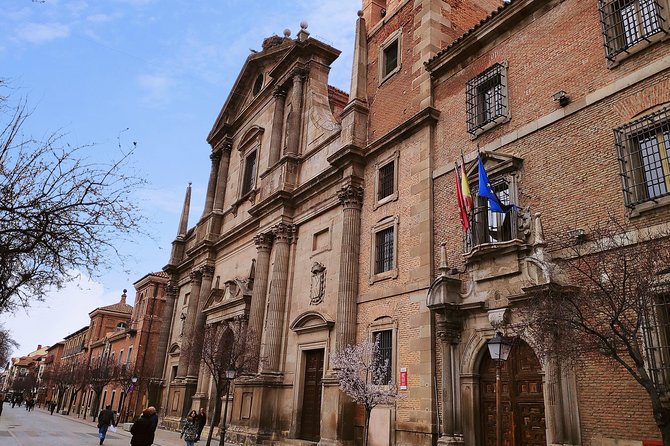
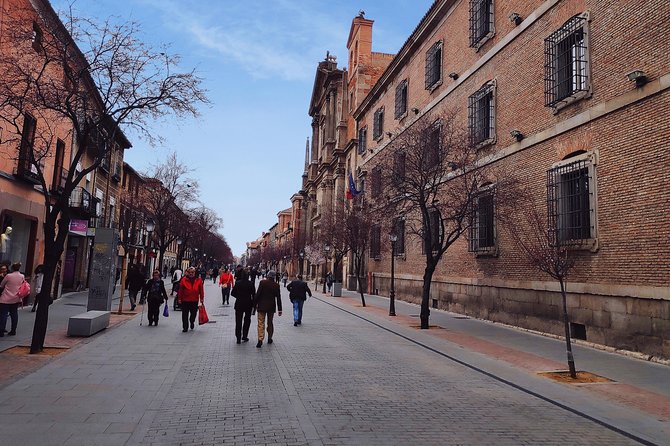
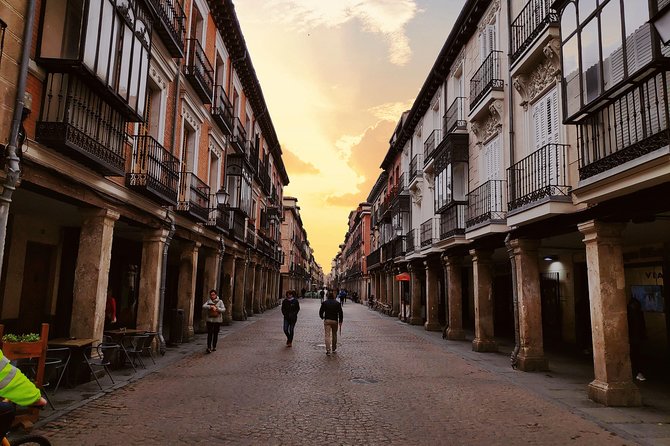
You then move to Calle Mayor, about 25 minutes, and you’ll see it as the commercial street the town relied on in the Middle Ages.
The street’s origin is tied to older layers of the city. The tour information connects Calle Mayor to the old Jewish aljama area, forming along the path of the Caesar Augusta Roman road that passed through Complutum.
You’ll also notice how the street worked socially and economically. Stores were placed at street level, while houses sat above, connected by galleries so residents could move without constantly descending into the public thoroughfare.
This stop is quick, but it helps you “read” the town as a living system. In other words, it turns Alcala from a list of buildings into a place where daily life happened in specific patterns.
If you like street-level history—how people moved, traded, and lived—Calle Mayor is a smart use of time.
Museo Casa Natal de Cervantes: birthplace debate, then museum detail
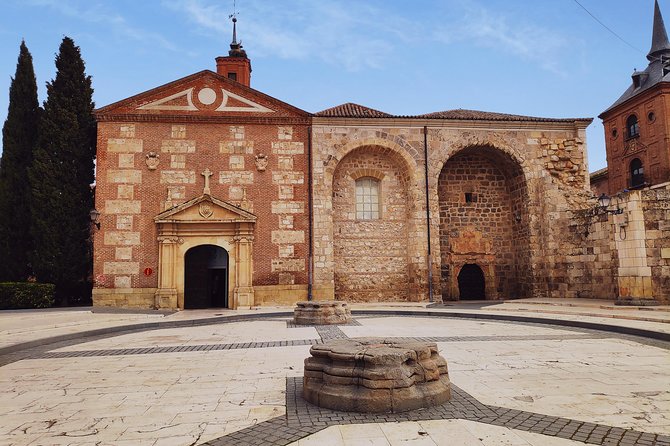
The emotional centerpiece of the day is Museo Casa Natal de Cervantes, around 35 minutes, with admission included. This is the building presented as the place of Miguel de Cervantes’ birth, identified in 1547, and it’s now the Cervantes museum and library.
One reason this stop feels more than ceremonial is that the birthplace wasn’t always accepted as settled. The tour description explains that Cervantes’ birthplace had long been debated. It wasn’t until 1948 that Luis Astrana Marín—author of The Heroic and Exemplary Life of Miguel de Cervantes Saavedra— proclaimed this building as Cervantes’ birthplace.
That history of uncertainty becomes part of the museum story. The property is described as located in the historic old city of Alcalá de Henares, next to the Hospital de Antezana, where Cervantes’ father, Rodrigo de Cervantes, worked. The city council bought the property in 1954 to establish a Cervantes museum, and the current museum was inaugurated in 1956 as the Cervantes Museum and Library.
In the experience, you’re likely to appreciate the atmosphere people associate with historic interiors—especially the way the museum frames Cervantes with period details and family context. One reviewer highlight called out the antiques on view and the feeling of the house, which matches how these small, preserved spaces often work best: they make literature feel physical.
Catedral de Alcala de Henares: the political and social core in one place
You’ll finish at Catedral de Alcala de Henares (Catedral Magistral de Saints Justo and Pastor), about 10 minutes. The cathedral entry is not included, so this portion is more about the exterior and the guided orientation than a long sit-down visit.
Still, it matters. The tour notes that throughout the Middle Ages the cathedral acted as both religious and civic center. It’s described as having a concentric circle structure, with streets leading from gates of the walled enclosure into the cathedral area.
There’s also a specific origin story tied to early Christian martyrs. The cathedral is placed on the tradition-linked site of where saints Justo and Pastor were beheaded and buried in the early fourth century.
Even with a short stop, the way this location intersects with city design helps you understand why Alcala’s institutions weren’t separate from its streets. The cathedral sits where people gathered for more than worship—it also linked to governance and public life.
How the guide changes the whole day: Vicky, David, and Maria Jesús
This tour lives or dies by the guidance, and the reviews you shared underline a consistent pattern: guides who can connect names, places, and themes.
Names that came through clearly include Vicky, David, and Maria Jesús. People praised guides for clear explanations and for being available with questions, especially during the university and house-museum parts.
If you like history presented with structure—like why Cardinal Cisneros mattered, or how the street plan of Calle Mayor fits into everyday movement—this is the kind of tour where a good guide helps you “see the system.” Not just memorize dates, but understand how the town worked.
My practical advice: bring one or two questions with you before you leave Madrid. For example, ask how the University of Alcalá influenced intellectual life around Cervantes, or why the birthplace identification debate matters to how we interpret historical figures. You’ll get more out of the time inside the museum and the college if you’re actively listening for your answers.
What to do before and after: lunch, timing, and the Mercado Cervantino chance
Food and drinks aren’t included. That means you’ll want to handle lunch on your own, either before the tour starts or after you’re back in Madrid. If you’d like a smooth day, plan something easy that doesn’t rely on long restaurant reservations.
Timing-wise, plan your day around the tour’s ~5-hour duration and the fact that you’ll have several ticketed interiors. Wearing comfortable shoes is a must, since even short stops add up when you’re moving between the bus and the walking route.
One fun detail from the reviews: some people got a bonus highlight by experiencing the Mercado Cervantino, described as a yearly medieval festival. It’s not guaranteed on every date from the tour data you provided, but if your travel dates line up with the festival season, you might add extra atmosphere to your Alcala experience.
If you want to pair this trip with other Madrid history, consider doing it as your “literature and institutions” day, then keep the next day for neighborhoods where you can wander on your own.
Should you book this Cervantes day tour?
Book it if you want a focused, efficient day that combines Cervantes’ birthplace with the intellectual setting of the University of Alcalá. The value is strongest when you know you’ll want museum time and you prefer having admissions handled for you.
Skip it or reconsider if you hate walking between multiple stops within a tight timeline, especially if your schedule is very rigid. Also note that the cathedral stop doesn’t include entry, so if you were hoping for a long cathedral visit, you may feel you’re only skimming that portion.
If you’re a first-timer in Alcala de Henares, this tour gives you a fast, organized path through the highlights that actually explain the town. And if you love literature-history connections, the Cervantes house museum and the university complex are the kind of pairing that makes the whole day click.
FAQ
How long is the Alcala de Henares and Cervantes guided tour from Madrid?
The tour lasts about 5 hours.
What’s included in the price?
The price includes the official guide and walking tour, round-trip transportation by air-conditioned bus, admission to Colegio de San Ildefonso (University of Alcalá de Henares), and admission to the Cervantes Museum and Library. Plaza de Cervantes and Calle Mayor stops are free to enter, while the cathedral entry is not included.
Is food included during the tour?
No. Food and drinks are not included, so you’ll need to plan your own lunch or snacks.
Do I need a face mask?
Yes. Face masks are mandatory during the tour. If you forget yours, you can buy one for €1.
How big is the group?
This tour has a maximum of 50 people.
Can I cancel for a refund?
Yes. You can cancel up to 24 hours in advance for a full refund.