Segovia hits fast, even on a half-day. This guided day trip packs the Roman aqueduct and Segovia’s medieval center into one smooth route, then leaves you with ample free time at the end to eat and wander at your own pace. I like that the plan gives you structure for the big sights, without locking you into a rigid schedule.
The main thing to watch is timing: if the bus pickup is late, you may feel the day get squeezed. One trip report mentioned a pickup about 35 minutes late, and the group still had to leave Segovia on time, so the walking-and-seeing portion felt shortened. Still, when the logistics run well, you get a comfortable ride and clear guidance from a bilingual official guide.
If you want a big Segovia hit without the hassle of buses and tickets on your own, this experience is built for that. It runs about 11 hours, starts at 9:00am in Madrid, uses an air-conditioned vehicle, and caps groups at 55 travelers, which helps keep the walking portion manageable.
In This Review
- Key Things You’ll Notice on This Segovia Tour
- A Half-Day Feeling: The Madrid-to-Segovia Flow
- Roman Aqueduct: The Icon You See Before You Even Finish Walking
- Segovia Cathedral and St Stephen’s Church: Gothic and Romanesque Side by Side
- The Alcázar of Segovia: A Castle-Palace That Looks Like a Ship’s Bow
- The Walk Between Stops: How Segovia Mixes Roman, Gothic, and Medieval Streets
- Free Time at the End: Use It for Food, Views, or Just Unhurried Wandering
- Price and Value: What $51.20 Gets You (and Where It Might Feel Tight)
- Who Should Book This Segovia Trip From Madrid?
- Should You Book the Segovia Experience?
- FAQ
- Where does the tour start?
- What time does the tour start?
- How long is the experience?
- Does the tour include transportation from Madrid and back?
- What’s included in the guided portion?
- Is there a ticket involved?
- What stops are visited during the tour?
- Is free time provided?
- How big are the groups?
- Is free cancellation available?
Key Things You’ll Notice on This Segovia Tour
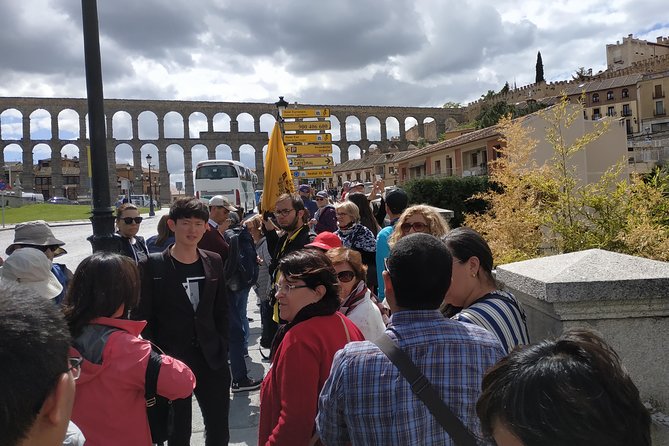
- Roman aqueduct first: a preserved elevated Roman structure that’s basically Segovia’s signature view
- Bilingual official guide (English-Spanish): clear explanations while you walk through the city core
- Three eras in one route: Roman, Gothic, Romanesque, then medieval castle walls nearby
- Alcázar’s dramatic setting: a fortress-castle-palace on a rocky crag shaped like a ship’s bow
- Free time at the end: you’re not rushed out immediately after the guided stops
A Half-Day Feeling: The Madrid-to-Segovia Flow
Even though it’s described as half-day, the day still starts like a real trip: pick-up in Madrid at C. de San Bernardo, 5 at 9:00am, then time on the road to reach Segovia. The big advantage of this format is that you get guided highlights without spending the whole day trapped in a coach.
Once you arrive, you’ll do a guided walking route around Segovia’s key sights, including short stops to absorb what you’re looking at. Then you’re released for ample free time later on, and the tour ends back at the meeting point in Madrid. That back-to-the-start structure matters. It reduces the chances you end up planning last-mile travel while you’re tired.
The tour also includes transportation to and from Madrid, which is a huge value point. Even if you’re comfortable with Spanish transit, it’s one less thing to coordinate on a tight schedule.
You can also read our reviews of more tours and experiences in Madrid.



Roman Aqueduct: The Icon You See Before You Even Finish Walking
The first major stop is one of Spain’s most instantly recognizable Roman views: an elevated Roman aqueduct that’s still preserved and intact, and the foremost symbol of Segovia. This is one of those rare sights where a quick stop can still feel satisfying, because the structure is so visually legible. You don’t need a deep background to get why it impresses.
What makes this stop especially smart on a guided day trip is pacing. Roman aqueducts can be long and complex, but you get the core visual impact early, before fatigue sets in. Then the rest of the route can feel like a conversation that builds on it: stone engineering, then cathedrals and churches, then the Alcázar rising above everything.
Also, if you’re coming from Madrid, this first “wow” is a clean mental switch. Your brain clocks Segovia as a different place right away. It sets the tone for the medieval streets afterward, because you’ll start noticing how many styles are packed into one compact city.
Segovia Cathedral and St Stephen’s Church: Gothic and Romanesque Side by Side
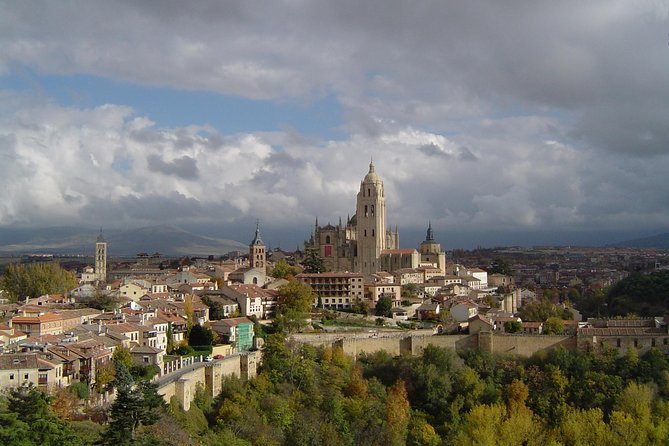
After the aqueduct, the tour focuses on two key religious landmarks, each representing a different medieval layer of the city.
First up is Segovia Cathedral, a Gothic-style Roman Catholic cathedral located in the main square. It’s dedicated to the Virgin Mary and was built in a Gothic style in the mid-16th century. Because this is in the main square area, it’s the kind of stop where you can both look up at the architecture and also reset your bearings. If you’re the type who likes to find a central “anchor” point in a new city, this works.
Then you’ll visit the Church of St Stephen, a medieval church dating from the 12th century. The detail that matters here is the Romanesque bell tower, which gives you a different texture than the cathedral’s Gothic styling. Even if you don’t think of church architecture as your main interest, this pairing helps you understand how Segovia’s stonework evolved across centuries.
The practical upside: these stops help fill time during the walking portion with sights that are close enough to keep the group moving, but distinct enough that you don’t feel like you’re ticking boxes. You’ll also be better positioned for the Alcázar later, because these landmarks help you read the city’s shape and scale.
The Alcázar of Segovia: A Castle-Palace That Looks Like a Ship’s Bow
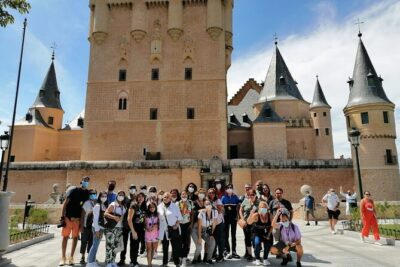
The highlight is the Alcázar of Segovia, and it’s the kind of place where the exterior alone can carry the day. The Alcázar is a medieval alcázar that sits on a rocky crag above the confluence of two rivers near the Guadarrama mountains. The shape is described as like the bow of a ship, and once you see that setting, you understand why it has such a strong visual identity.
It’s also UNESCO-listed as part of a World Heritage Site in Segovia, which is exactly the kind of designation that’s worth your attention. When you’re doing a short day trip, UNESCO status signals that the place isn’t just pretty—it’s significant and recognized for a reason.
What I find useful about knowing the Alcázar’s timeline is that it changes how you look at it. This building wasn’t only a palace. According to the tour details, it has served as:
- a fortress originally
- a royal palace
- a state prison
- a Royal Artillery College and a military academy
- and today it functions as a museum and military archives building
That history helps you stop treating it like a single-purpose castle photo op. It’s been used, re-used, and re-imagined over time, which is why its role in Segovia feels so layered.
On a cold day, one trip report mentioned that a cafeteria at the palace served hot drinks such as host chocolate and Irish coffee—the kind of small, realistic comfort that matters when you’re spending hours outdoors and walking uphill. Even without promising the exact menu, plan for warm clothing and take advantage of any nearby stop for coffee or hot chocolate if the weather turns.
The Walk Between Stops: How Segovia Mixes Roman, Gothic, and Medieval Streets
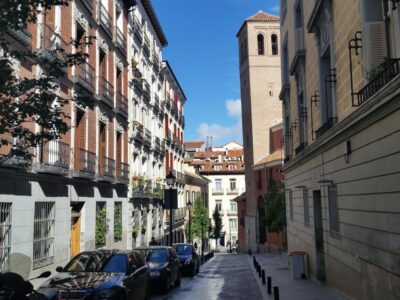
A big reason this tour works is that it doesn’t just do isolated monuments—it uses a walking route to connect them. You’ll see medieval streets while looking at Gothic, Spanish, and Roman architecture in the same general day.
This is where you get the “Segovia feeling” beyond the major monuments. The medieval layout means you’ll likely be weaving through narrow lanes and open sightlines—enough variety to keep the walking portion from feeling repetitive. And because the tour is guided, you don’t have to guess what you’re looking at. You can focus on learning what matters.
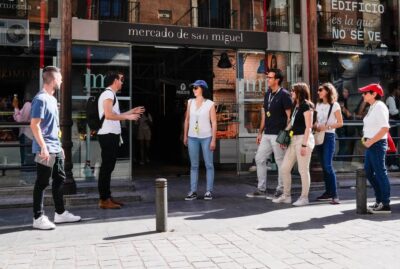
A group limit of 55 travelers also helps. It doesn’t mean you’ll have private attention the whole time, but it makes it easier to hear and to regroup after each stop. When tours get larger than this, the route can turn into a herding exercise. Here, the size is controlled enough to keep the day moving.






Free Time at the End: Use It for Food, Views, or Just Unhurried Wandering
The tour’s structure is built around one key gift: when the guided portion wraps, you get ample free time. That’s not just a line in the brochure—it’s what makes the day trip feel like yours instead of a checklist.
Here’s how to use that free time well:
- If you want your own pace, aim to return to the area around the Alcázar viewpoints. You’ll have better control over photos and time to sit for a minute.
- If you want a cultural break, find a café or simple sit-down meal and let the city slow you down.
- If you like walking, use the guided stops as your anchor points and explore the streets between them.
One reason I like this approach is that it protects you from the most common half-day trip problem: leaving feeling rushed. The free time means you can recover your energy after the guided route and still have a satisfying final chunk of the day.
Also, because the tour includes transport back to Madrid and ends at the meeting point, you’re not stuck hunting for your way back when your feet are tired. You just need to be back when the group time dictates.
Price and Value: What $51.20 Gets You (and Where It Might Feel Tight)
At $51.20 per person for an approximately 11-hour day with transport, a guided walking route, and an air-conditioned vehicle, the value is pretty clear. You’re paying for two things that cost time and stress if you do them alone:
- round-trip transport between Madrid and Segovia
- guided interpretation while you walk the core sights
You also get a bilingual English-Spanish official guide, and that’s a practical advantage if you want real context but don’t want to rely on your phone for every explanation.
Where value can feel less comfortable is pacing. If everything runs on schedule, you’ll have a solid mix of guided stops and independent time. If not, you might feel it. As mentioned earlier, one experience report described a pickup running about 35 minutes late and the group still having to depart Segovia on time, which shortened the on-site portion.
So my take is simple: this trip is a great deal when the day stays on track. It’s still worth it for the sights, but you should mentally plan for the possibility that time is less flexible than you’d like.
One more detail that supports value: your ticket is a mobile ticket, and confirmation happens at booking. That reduces friction so you can spend energy on the city instead of paperwork.
Who Should Book This Segovia Trip From Madrid?
This is a good match if you want a compact overview that still includes the big names: aqueduct, cathedral, a Romanesque bell tower church, and the Alcázar. It also suits you if you like learning while walking and then prefer to finish the day at your own pace.
You’ll especially like it if:
- you’re short on time in Madrid but still want a historic day trip
- you care about Roman and medieval architecture in one organized loop
- you’d rather let the logistics handle the transport than figure it out on your own
It might not be your best option if you want a very slow, deep, no-rush experience where you can linger for long periods at every stop. Even with free time at the end, the day is structured, and your schedule is shaped by the group’s departure needs back to Madrid.
Should You Book the Segovia Experience?
I’d book it if you want a high-impact Segovia day with minimal stress. The combination of an iconic Roman aqueduct, a Gothic cathedral in the central square, St Stephen’s Romanesque bell tower, and the Alcázar’s dramatic setting is exactly what you want on a limited schedule.
Here’s my decision checklist:
- If you like guided stops plus free time afterward, this format makes sense.
- If you hate being on a coach schedule all day, you might feel constrained—timing matters.
- If comfort on the road is a priority, the air-conditioned vehicle helps, and the group size cap keeps it from getting chaotic.
Given the price and what’s included, it’s strong value for a first-time Segovia visit from Madrid. Just give yourself a little flexibility for travel timing, pack warm layers if the weather is chilly, and plan to use that end-of-tour free time well—because that’s where the day becomes memorable on your terms.
FAQ
Where does the tour start?
The meeting point is C. de San Bernardo, 5, Centro, 28013 Madrid, Spain.
What time does the tour start?
The start time is 9:00am.
How long is the experience?
It runs for approximately 11 hours.
Does the tour include transportation from Madrid and back?
Yes. Transportation to and from Madrid is included.
What’s included in the guided portion?
You get a bilingual English-Spanish official guide and a bilingual guided walking tour around the city, plus an air-conditioned vehicle.
Is there a ticket involved?
Yes. The tour uses a mobile ticket.
What stops are visited during the tour?
The stops include the Roman aqueduct, Segovia Cathedral, the Church of St Stephen, and the Alcázar of Segovia.
Is free time provided?
Yes. You get ample free time at the end of the tour to eat, explore, and sightsee.
How big are the groups?
The tour has a maximum of 55 travelers.
Is free cancellation available?
Yes. You can cancel for a full refund up to 24 hours in advance of the experience start time.